

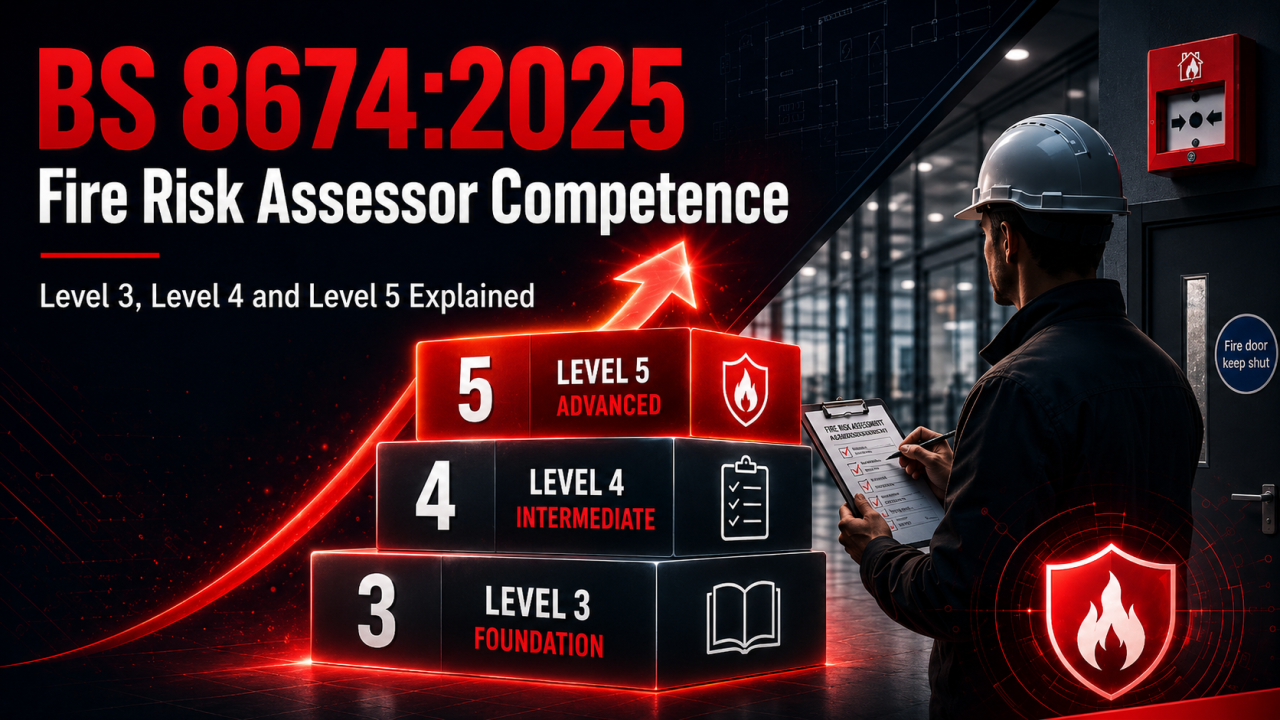
BS 8674:2025 Fire Risk Assessor Competence: Level 3, Level 4 and Level 5 Explained
BS 8674:2025 is changing how fire risk assessor competence is understood in the UK. The direction is right. Standards are improving. But the current position around Level 3, Level 4 and Level 5 fire risk assessment qualifications is still causing confusion for assessors, consultants and clients.
The simple version
Based on the current BAFE SP205 Life Safety Fire Risk Assessment Scheme direction, the position appears to be:
| Competence Level | Current Qualification Direction |
|---|---|
| Foundation | Level 3 |
| Intermediate | Level 4 |
| Advanced | Level 5 |
That sounds straightforward.
But for many practising fire risk assessors, and for the businesses appointing them, it is not.
Across the sector, assessors may hold a mixture of fire safety qualifications, health and safety qualifications, professional memberships, third-party certification, practical experience and specialist support arrangements.
Some have worked across offices, shops, residential blocks, care settings, commercial units, industrial premises and more complex buildings. Some have built competence through formal training. Some have built it through years of practical experience. Many have done both.
Now BS 8674:2025 has introduced a clearer framework for the competence of individual fire risk assessors. BAFE SP205 Version 6 has followed by setting out qualification expectations linked to that framework.
That is a good thing.
But the transition has created confusion.
What has changed with BS 8674 fire risk assessor competence?
BS 8674:2025 is about the competence of individual fire risk assessors.
It is not just about whether someone has attended a course. It is about whether they have the right knowledge, experience, skills, behaviours and judgement for the type of premises they are assessing.
BAFE’s current SP205 qualification document refers to fire risk assessors demonstrating and maintaining the necessary skills, knowledge, experience and behaviours to undertake fire risk assessments. It also refers to regulated qualifications being mapped against BS 8674.
Plain English point
The industry is moving away from vague claims of competence and towards clearer evidence. That is sensible. But assessors need to know exactly what evidence is expected before they spend thousands of pounds on training.
The three levels explained simply
The current structure can be understood like this:
Foundation
For moderate-to-low risk premises.
This does not mean all buildings. It means simpler, lower-risk environments where the fire risks and fire safety arrangements are less complex.
Intermediate
For moderate risk premises.
This may cover more involved buildings, but it is not the same as being competent for all higher-risk or complex premises.
Advanced
For all building and premises types.
This is the level aimed at complex, higher-risk and more demanding fire risk assessment work.
That is the key issue.
Foundation does not mean all buildings.
Intermediate does not mean all buildings.
Advanced is the level aimed at all building and premises types, including higher-risk and more complex work.
Where the confusion starts
For years, Level 4 has often been spoken about in the context of more advanced fire risk assessment. Some older qualification titles and course descriptions have also referred to high-risk premises at Level 4.
That is where many assessors are now becoming unsure.
The current BAFE SP205 qualification matrix places recognised Level 4 qualifications under the Intermediate level. The Advanced level currently includes Level 5 qualifications, including FireQual and ProQual routes.
The current position in plain terms
Level 3 = Foundation
Level 4 = Intermediate
Level 5 = Advanced
This also broadly reflects the way FireQual fire risk assessment qualifications are now presented, with Level 3 Foundation, Level 4 Intermediate and Level 5 Advanced routes.
That is a significant shift in how many people may have understood the landscape.
It raises obvious questions:
- Where does an older Level 4 qualification now sit?
- How are previous qualifications and practical experience recognised?
- How much weight is given to years of real-world fire risk assessment work?
- Does an assessor need Level 5 for higher-risk buildings?
- What will clients, insurers and certification bodies expect?
- Should an assessor book Level 4, Level 5, or seek recognition of prior learning?
These are not academic questions.
They affect what work assessors accept. They affect business decisions. They affect professional credibility. They affect cost.
The cost is real
This is where the sector needs to be honest.
Training is not cheap.
A fire risk assessor may need to consider:
- course fees;
- VAT;
- travel;
- accommodation;
- time away from work;
- post-course assignments;
- third-party certification costs;
- professional memberships;
- CPD requirements;
- insurance implications.
For a large organisation, that may be manageable.
For an independent assessor or small consultancy, it is a serious investment.
The problem
Assessors should not have to spend thousands of pounds trying to guess which route will be recognised. If Level 4 now means Intermediate, and Level 5 means Advanced, that needs to be communicated clearly and consistently.
This is not about criticising training providers
This article is not intended to criticise any individual training provider, awarding body or certification organisation.
The issue is wider than that.
As part of our ongoing due diligence, Safety Inspectors UK Ltd has reviewed the current BAFE SP205 qualification requirements and spoken with training providers about the changing qualification landscape.
What became clear is that the sector is still adjusting to the BS 8674 framework.
Different people are trying to interpret what older qualifications mean, how existing experience is recognised, and what route is now appropriate for assessors working across different premises types.
That is the confusion.
And that confusion is now cascading down to working fire risk assessors and the clients trying to appoint them.
Our approach at Safety Inspectors UK Ltd
Matching competence to risk
Safety Inspectors UK Ltd does not treat fire risk assessments as a tick-box exercise. We consider the complexity of the premises, the occupancy profile, the fire safety arrangements and the competence required for the specific instruction.
The key issue is not whether one individual assessor holds one specific certificate. The issue is whether the person or organisation appointed can demonstrate that the right level of competence has been matched to the risk profile of the premises.
Where a building requires specialist input, higher-level review or additional technical expertise, we are able to draw on appropriate competent support within our wider fire safety consultancy arrangements.
The aim is simple: match the right level of competence to the right type of premises.
Experience still matters
A certificate alone does not make someone competent.
A good fire risk assessor needs more than a course.
They need to understand buildings. They need to understand people. They need to understand fire safety management, means of escape, fire doors, compartmentation, alarms, emergency lighting, extinguishers, evacuation strategy and the limits of their own competence.
They need judgement.
They need report-writing ability.
They need to know when to give a proportionate recommendation and when to refer to a specialist.
So this should never become a tick-box exercise where a certificate replaces professional judgement.
But equally, experience alone may no longer be enough unless it can be evidenced properly.
The balanced view
Competence is not just a certificate. But the industry is clearly moving towards structured evidence of competence, including regulated qualifications mapped against BS 8674.
What clients need to understand
Clients should stop asking one basic question:
“Are you qualified?”
That is not enough.
The better question is:
“Are you competent for this type of building, and can you evidence that competence?”
There is a big difference between a small office and a complex residential block.
There is a big difference between a simple shop and a care setting.
There is a big difference between a low-risk premises and a building with single stair escape, vulnerable occupants, complex evacuation arrangements, heritage features, combustible external wall concerns or poor compartmentation.
In more complex buildings, accurate building information, records and layout plans can also support better assessment. Services such as fire floor plans can help clients understand escape routes, fire safety assets and site arrangements more clearly.
The assessor should match the risk.
Not every assessor needs to assess every building.
But every assessor should know their limits.
What fire risk assessors should do now
My view is simple.
Do not panic.
But do not ignore it.
If you carry out fire risk assessments, now is the time to review your own position.
Ask yourself:
- What types of buildings do I assess?
- Are they foundation, intermediate or advanced risk?
- Do my qualifications match the type of work I am doing?
- Can I evidence my experience?
- Do I need a regulated qualification mapped against BS 8674?
- If I want BAFE SP205 registration, what qualifications are currently recognised?
- Am I relying on an old understanding of Level 4 that may no longer reflect the current position?
These are uncomfortable questions.
But they are necessary.
The wider direction of travel
The professionalisation of fire risk assessors is not only a standards issue. It is also becoming a live regulatory and policy issue.
The GOV.UK fire risk assessors profession consultation shows that the future development, regulation and competency requirements of the fire risk assessor profession remain under active consideration.
That reinforces the point: fire risk assessor competence is moving towards greater scrutiny, clearer evidence and higher accountability.
Our position
We welcome BS 8674:2025.
We support higher standards.
We support clearer competence levels.
We support clients being able to appoint fire risk assessors with more confidence.
But the sector needs to communicate better.
Right now, many assessors are trying to make expensive decisions while the terminology is still settling down.
Level 4 has previously been associated by some with higher-risk or advanced fire risk assessment work. The current BAFE SP205 recognised qualification structure now appears to place Level 4 at Intermediate and Level 5 at Advanced.
That is a significant change.
Assessors need to understand it.
Clients need to understand it.
Training providers, awarding bodies and certification bodies need to explain it clearly.
Final thought
Raising standards is the right thing to do.
But raising standards without clear communication creates confusion.
BS 8674:2025 should help the industry move forward.
BAFE SP205 Version 6 gives more structure.
But the people doing the work need plain answers.
Not vague course titles.
Not assumptions.
Not expensive guesswork.
The bottom line
Fire risk assessors need to know what level they are, what buildings they are competent to assess, and what qualification route is recognised — before they spend the money.
Need support with fire risk assessments?
Safety Inspectors UK Ltd provides practical, proportionate fire safety support for businesses, landlords and Responsible Persons.
We help clients understand their fire safety duties, identify suitable control measures, and take a sensible approach to compliance.
For more complex premises, we ensure the right level of competence is considered before accepting or allocating work, including drawing on appropriate specialist support where required.
If you need a fire risk assessment or support reviewing your existing fire safety arrangements, contact Safety Inspectors UK Ltd.