

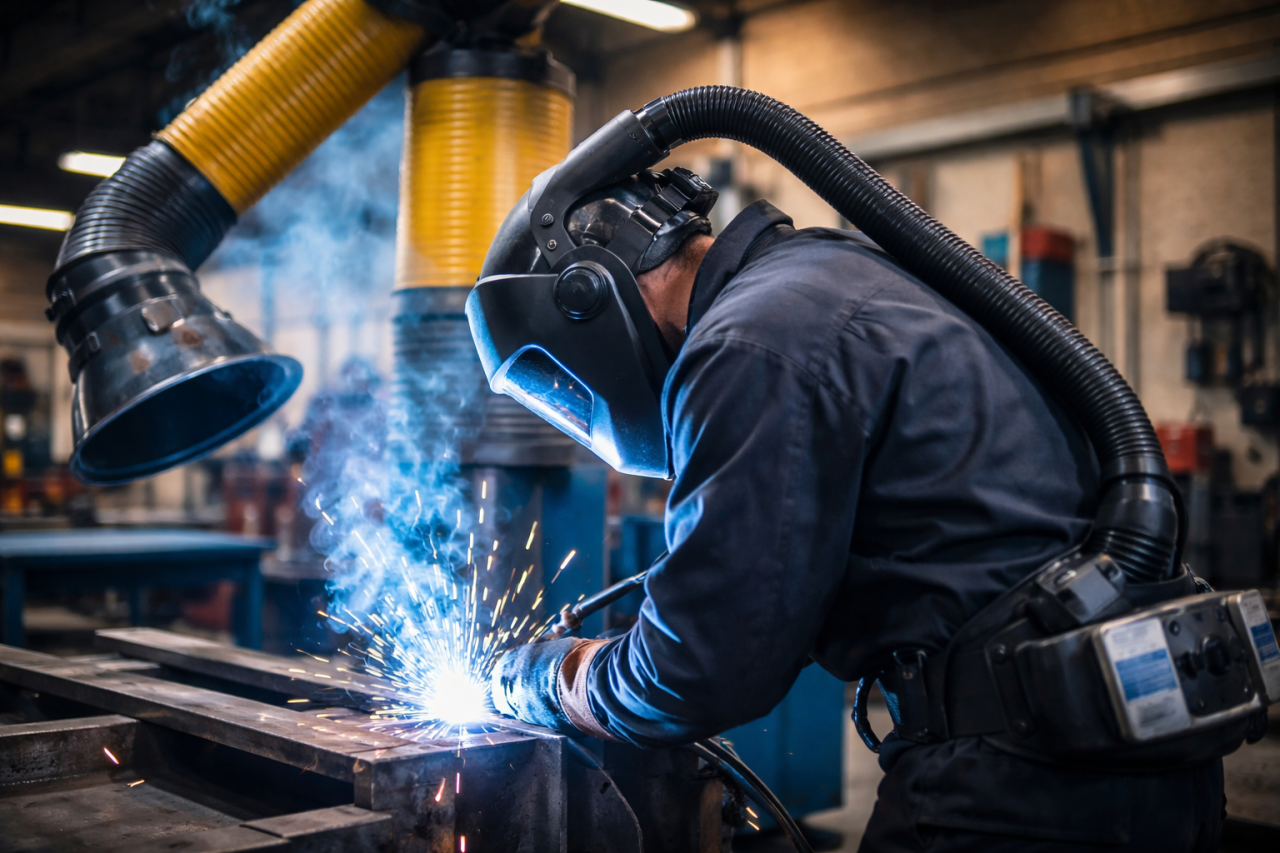
“It’s Only Occasional Welding”… Until It Isn’t
Making Defensible Decisions on Welding Fume Control Using the BOHS Selector Tool
For many businesses, welding is not a core activity.
It happens occasionally — maintenance, repairs, minor fabrication — and because of that, welding fume control is often treated as a secondary issue.
That is exactly where risk creeps in.
From an enforcement perspective, occasional does not mean low risk, and it does not reduce an employer’s duty to control exposure to welding fumes, which are now clearly recognised as a serious health hazard.
Recently, we undertook a focused review of welding activities in a setting where welding was carried out intermittently rather than continuously. The aim was simple: to check whether the control measures in place were proportionate, suitable, and defensible.
The Key Question
It is not simply “How often do we weld?” It is “How have we assessed the exposure, selected the controls and demonstrated that they are adequate?”
Why Occasional Welding Needs Closer Scrutiny
In many workplaces, occasional welding presents greater challenges than routine welding because:
- Controls are temporary or improvised
- Workspaces are not designed as welding bays
- Ventilation arrangements vary task to task
- PPE use is inconsistent or misunderstood
Health effects linked to welding fumes — including chronic lung disease and lung cancer — are cumulative. Exposure risk exists regardless of how frequently welding takes place.
From an HSE perspective, the question is not how often welding occurs, but how exposure has been assessed and controlled.
Using the BOHS Welding Fume Control Selector Tool
As part of this review, we used the Welding Fume Control Selector Tool developed by the British Occupational Hygiene Society (BOHS), in collaboration with industry specialists, academics, consultancies, and the Health and Safety Executive (HSE).
The tool is designed to support managers and supervisors by:
- Linking common welding tasks to expected control approaches
- Considering the welding process and work environment
- Providing structured guidance without technical overload
It is explicit that the tool does not replace a full risk assessment. Instead, it supports informed decision-making and helps ensure that control measures are selected logically and proportionately.
Engineering Controls First: The Role of LEV
One of the key outcomes of this exercise was reaffirming the central role of local exhaust ventilation (LEV) as the primary control measure for welding fumes wherever it is reasonably practicable.
LEV works by capturing welding fume at source, preventing it from dispersing into the wider workplace. When properly selected, positioned, maintained, and used, it:
- Reduces exposure for the welder
- Protects others working nearby
- Limits background contamination of the workspace
From a compliance standpoint, LEV represents an engineering control, which sits higher in the hierarchy of control than personal protective equipment.
Poorly positioned or inadequately maintained LEV, however, offers little real protection and may give a false sense of control. This is why the BOHS tool is supported by Control and Management Sheets, which reinforce the importance of correct use, training, inspection, and maintenance.
RPE and Air-Fed Masks: Protecting the Individual
Where LEV alone cannot adequately control exposure — for example in confined spaces, poorly ventilated areas, during outdoor welding, or during higher fume-generating processes — respiratory protective equipment (RPE) becomes necessary.
This is where a critical distinction must be understood:
Respiratory protective equipment protects the individual wearing it.
Local exhaust ventilation controls welding fume at source and helps protect both the welder and others in the surrounding area.
RPE, including air-fed welding masks, can be highly effective, but only when:
- Correctly selected for the hazard
- Properly maintained and inspected
- Used consistently and correctly
- Supported by training and supervision
RPE should therefore be viewed as a supplementary control, addressing residual risk rather than compensating for the absence of effective engineering controls.
Tight-Fitting RPE Must Fit the Individual Wearer
Where a welder uses tight-fitting RPE — such as an FFP2 or FFP3 disposable respirator, or a reusable half-mask respirator — simply issuing the correct specification of mask is not enough.
Tight-fitting respirators rely on creating an effective seal against the wearer’s face. Because face shapes and sizes differ, a particular make, model or size of respirator may fit one employee but not another.
For this reason, tight-fitting RPE should be face fit tested to the individual wearer. The wearer also needs to be clean shaven wherever the respirator sealing surface contacts the face.
A successful face fit test relates to the specific make, model, type and size of respirator tested. If the employee later changes to a different facepiece, further face fit testing may be required.
On-Site RPE Face Fit Testing
Using FFP2, FFP3 or tight-fitting half-mask RPE?
Safety Inspectors UK provides on-site qualitative face fit testing for appropriate FFP2, FFP3 and reusable half-mask RPE across Middlesbrough, Teesside and North East England, with nationwide workplace testing also available.
For further information on face fit testing, see HSE INDG479 – Guidance on RPE Fit Testing.
Understanding Air-Fed Mask Options
During the review, particular attention was given to air-fed welding masks, which broadly fall into two categories:
Important distinction: not every form of RPE requires a face fit test.
Many powered or supplied-air welding helmets use a loose-fitting hood or headtop and do not rely on a tight face seal. Face fit testing applies where the RPE incorporates a tight-fitting facepiece.
Compressed Air-Fed Systems
- Supplied from a compressor
- Air passes through multi-stage filtration to breathing-air standards
- Typically suited to fixed installations
- Require robust inspection, testing, and management arrangements
Powered Air-Purifying Respirators (PAPR)
- Belt- or hip-mounted battery-powered units
- Draw air through high-efficiency filters before supplying the helmet
- Well suited to mobile or occasional welding tasks
- Still dependent on correct filter selection, charging, cleaning, and training
Both systems can form part of a compliant control strategy where justified by risk, but neither should be treated as a standalone solution in place of suitable ventilation.
Useful HSE Guidance on RPE
Face fit testing is only one part of effective respiratory protection. Employers should also consider the adequacy, suitability, selection, maintenance and correct use of RPE.
Making Decisions That Stand Up to Scrutiny
From an HSE inspection or incident investigation perspective, the key question is rarely what equipment was available, but:
How were control measures selected, and why were they considered adequate?
Using structured tools such as the BOHS Welding Fume Control Selector — alongside a task-specific risk assessment — helps demonstrate that:
- The hazard was properly understood
- Controls were selected in line with recognised guidance
- The hierarchy of control was applied
- Decisions were proportionate and defensible
Final Thoughts
Occasional welding is often where gaps in control go unnoticed, not through negligence, but through assumption.
Taking the time to review welding fume controls — particularly where activities are infrequent or changeable — helps ensure that arrangements remain effective, compliant, and appropriate.
In many cases, the most important control measure is not additional equipment, but clarity:
- clarity on risk
- clarity on responsibility
- clarity on why specific controls are in place
That clarity is what ultimately protects workers — and the business — when it matters most.
Respiratory Protection Support
Using tight-fitting RPE for welding?
If your welding controls include FFP2, FFP3 or reusable tight-fitting respiratory protection, make sure the selected respirator actually fits the person wearing it.
Safety Inspectors UK provides professional on-site qualitative face fit testing across Middlesbrough, Teesside, the wider North East and throughout the UK.