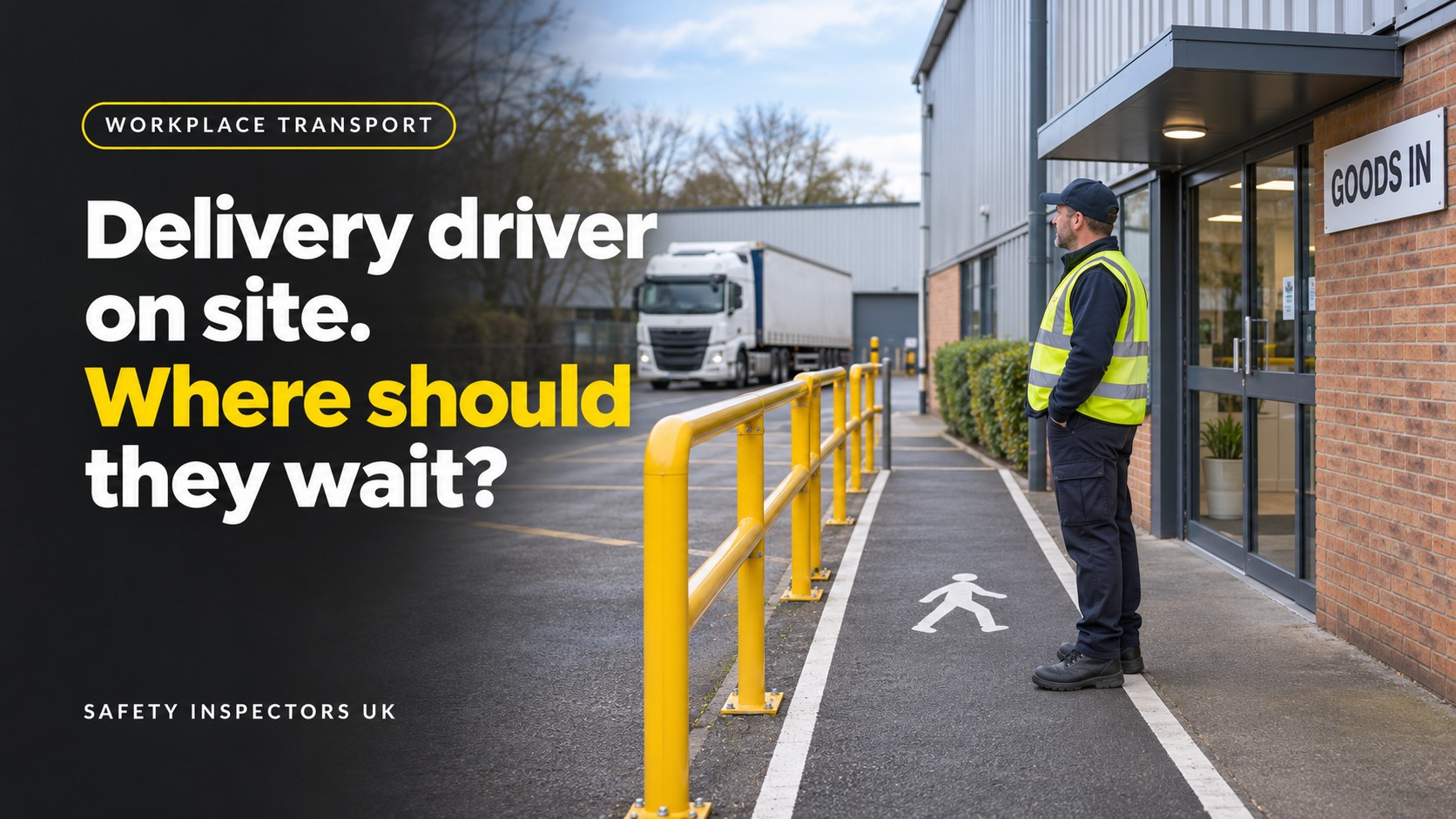
WORKPLACE TRANSPORT · PRACTICAL GUIDE
Delivery driver waiting areas · North East manufacturing and engineering
A lorry arrives. The driver gets out. Nobody is at goods-in.
What happens next should not depend on the driver finding someone willing to sign. If the obvious route leads through a working yard, your arrival arrangements need attention before the next delivery.
For manufacturing and engineering businesses across the North East, the question is practical: where can a visiting driver safely report, wait and get help? The answer needs to work during breaks, shift changes and unexpected arrivals, as well as when the usual supervisor is available.
Start before the vehicle reaches the gate
Share the essential site information through the supplier or haulier: the right entrance, arrival contact, parking instructions and restrictions that affect the delivery. Check that it reaches the person driving, including a replacement or agency driver.
HSE’s Delivering safely guidance recommends agreeing responsibilities between the supplier, carrier and recipient. Include the handover before unloading, the driver’s location during the operation and what to do if arrangements are unsafe.
Keep your own instructions usable. A short arrival sheet with an annotated plan may be more useful at the gate than a long policy. Test it by asking someone unfamiliar with the site to explain their first three steps. If they have to guess, revise it.
Choose a safe waiting place—not a spare corner
Assess the waiting location against the actual movements and loads nearby. Keep people away from vehicle activity, suspended loads and areas where materials could fall. The route to the waiting area matters just as much as the destination.
HSE’s guidance on separating pedestrians and vehicles prioritises separate routes wherever reasonably possible. Protect doorways and provide suitable crossing arrangements where routes meet. Paint alone cannot physically stop a vehicle entering a pedestrian area.
Do not automatically tell every driver to stay in the cab. HSE notes that this can be unrealistic or unsafe for some unloading operations. Decide the appropriate arrangement for the task, including safe access to welfare facilities and any necessary observation of loading.
Would a new driver know what to do?
A workplace inspection can test your arrangements against what actually happens on site: where drivers park, how they reach reception and where they wait.
Practical example: the unanswered goods-in door
Consider an engineering business receiving components halfway through a shift handover. The delivery is expected, but the named contact has gone home. The driver sees an open workshop door beyond the yard and considers walking over to ask for help.
A better arrangement would give that driver a clear backup contact at the reporting point. A designated member of the receiving team would take over the delivery, confirm the waiting location and explain how the driver will be contacted. If the agreed arrangements cannot be provided, unloading would pause while a safe alternative is agreed.
The management check is simple: ask the late shift to describe the same process. If their answer is different, the written instruction has not yet become a reliable working arrangement.
Make the handover unmistakable
Avoid an informal wave being interpreted as permission to start. Agree a clear signal or communication method between the receiving team and driver. Confirm who is in charge, who must remain clear and how concerns are raised.
Include a controlled release when the operation finishes. The driver and receiving team should know when it is safe to return to the vehicle and prepare to leave. Where your assessed system uses vehicle restraints, key control or other safeguards, make sure the procedure explains who controls them. Do not assume one method suits every vehicle and delivery.
Review the full operation using HSE’s workplace transport inspection checklist, including supervision, vehicle movements, unloading and driver competence. A waiting area is one part of the system.
Five questions for your next delivery
- Can the driver find the reporting point? Check the view from the entrance, not from your office.
- Who answers if the usual contact is unavailable? Test the backup arrangement during breaks and shift changes.
- Is the waiting place still safe today? Check temporary storage, parked vehicles and access to welfare facilities.
- Does everyone understand the handover? Ask the driver and receiving team separately.
- What happens if something changes? Give staff and visiting drivers a clear way to stop and raise a concern.
Does this need a separate waiting room?
The appropriate provision depends on your site and delivery risks. The aim is an assessed safe place with a safe route and workable communication—not simply a room with a sign. Review what drivers actually need while on your premises.
Make the next delivery easier to manage.
For North East manufacturing and engineering businesses, we can review delivery arrangements, identify gaps and help prioritise practical improvements. Tell us what happens between your gate and goods-in.
Guidance checked: 9 November 2026. Sources linked above are HSE guidance for Great Britain. Use this article alongside a site-specific assessment. Cover: AI-generated image.