BONFIRE NIGHT · SAFETY WITHOUT SPOILING THE FUN
Bonfire Night has plenty going for it. Bright colours. Big bangs. Hot food eaten while wearing gloves.
Then somebody says:
“Hold my drink. I’ll see why that one hasn’t gone off.”
And suddenly, we need to talk about safety.
At Safety Inspectors UK, we want people to enjoy themselves. A good evening involves watching the fireworks, debating which was the best one and discovering that nobody bought enough ketchup.
A few sensible precautions help keep it that way. Here is our guide to Bonfire Night firework safety, with the fun firmly intact.
“I’ve done this for years” isn’t an instruction manual
Experience is useful. Reading the instructions is still necessary.
Different fireworks need different arrangements and safety distances. The space available should determine what you buy—not the size of the box you can squeeze into the trolley.
Buy from a reputable retailer. Read the instructions before the display, while you can see properly and nobody is asking when it starts.
Check the viewing area, surrounding buildings, overhead obstructions and where debris could fall. If you cannot provide the required space, choose a different option.
The manufacturer’s safety distance does not become smaller because your garden ends at the fence.
See the government guidance on planning non-professional displays.
Give the important job to someone sober
The person lighting the fireworks needs a clear head.
“Surprisingly confident after three drinks” is not the qualification we are looking for.
Keep fireworks in a closed box, take them out one at a time and keep ignition sources away. Follow the instructions, use a torch to read them and light at arm’s length using a taper.
Keep spectators at the specified distance, with children supervised.
Nobody needs a closer look for their phone camera. The zoom function has been preparing for this moment.
The quiet firework is not asking for assistance
A firework that fails to go off can tempt people into approaching it.
Perhaps it needs encouragement. Perhaps the fuse needs another go. Perhaps leaning over it will reveal the problem.
Curiosity is excellent in many situations. This is a particularly poor one.
For organised displays, make sure the operator has arrangements for dealing with failed fireworks and clearing the site safely afterwards.
Fire safety matters after the fireworks, too.
For managers responsible for workplace premises, SIUK’s fire risk assessments help turn fire safety concerns into clear, prioritised actions.
Explore workplace fire risk assessmentsSparklers: small does not mean harmless
Sparklers look friendly. They are still hot enough to cause burns.
Keep the rules simple:
- Never give sparklers to children under five.
- Supervise children closely.
- Wear gloves, hold sparklers at arm’s length and light one at a time.
- Never hold a baby while using a sparkler.
- Put used sparklers into a bucket of cold water.
Writing your name in the air is optional. Keeping a hot sparkler away from somebody else’s coat is essential.
RoSPA’s Firework Code covers these precautions and recommends professionally organised public displays as the safest way to enjoy fireworks.
Your neighbours haven’t necessarily bought tickets
Your display might last ten minutes. Its impact can travel considerably further than your garden.
Give neighbours advance notice so they can prepare children, pets or anyone who finds unexpected noise distressing. Consider quieter fireworks and the animals nearby.
Clear up responsibly, too. For spent fireworks and debris, current government advice is to wait until everything has completely cooled, then soak it overnight before bagging and disposing of it appropriately. Failed or unused fireworks need separate safe-disposal advice; never approach a failed firework to start clearing up.
A good host deals with the aftermath as well as the entertainment.
Hosting through work, a club or a community group?
A bigger audience needs more planning than “everyone stand somewhere over there”.
HSE’s guidance for display organisers advises rechecking the site, weather and wind direction on the day. Keep spectators out of firing, safety and fallout zones, and prevent people bringing their own fireworks.
If there is a bonfire, check for children and animals before lighting it. Never use petrol or paraffin.
Consider using a professional display operator. Being excellent at organising the refreshments does not automatically make you the right person to manage explosives.
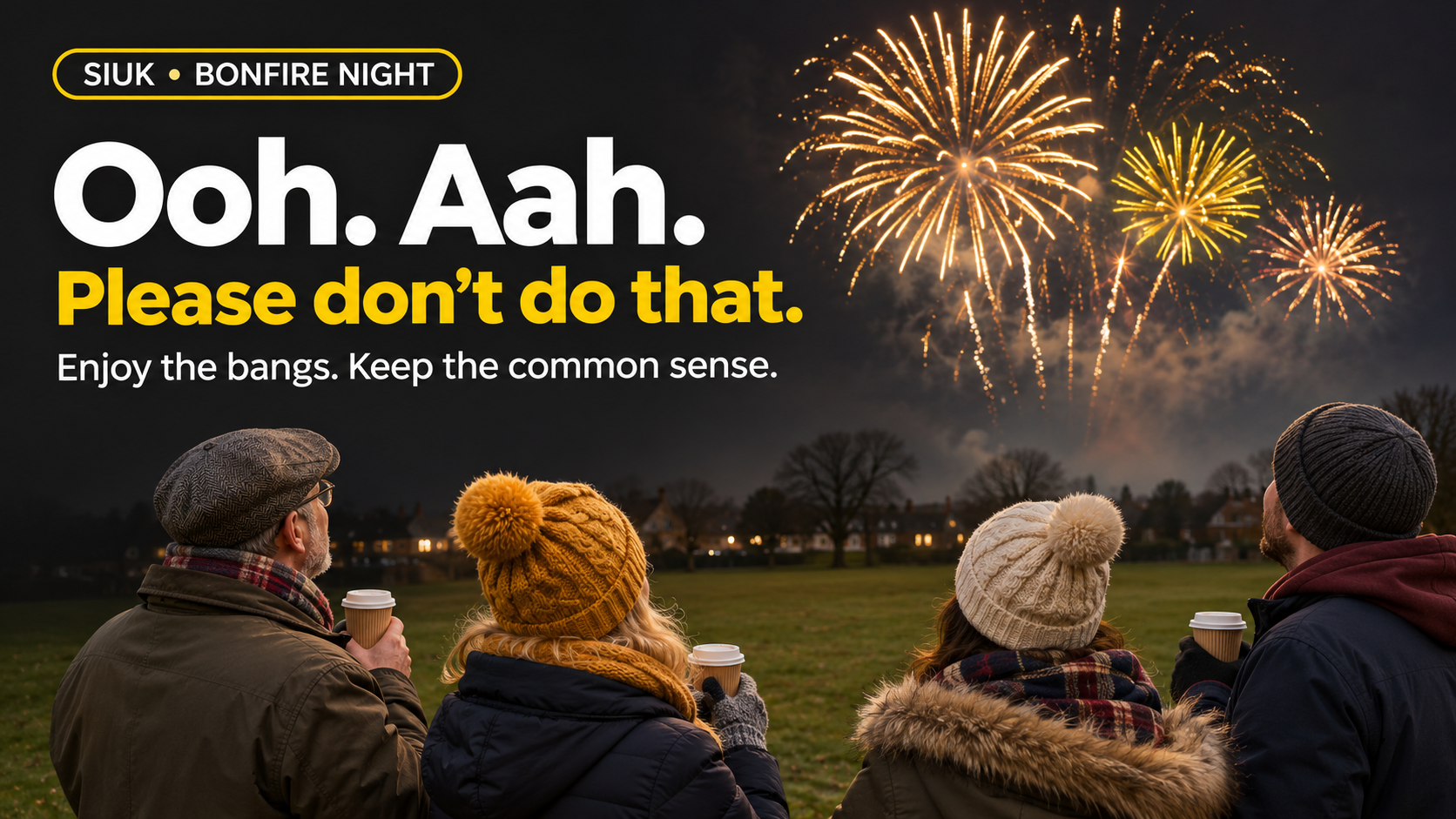
Enjoy the bangs. Keep the common sense.
The aim is a good evening: warm coats, something tasty and a sky worth looking up at.
Read the instructions. Keep your distance. Look after the people around you.
And if somebody says, “It’ll probably be fine,” take that as your cue to check.
Practical safety support. All year round.
Need help with wider workplace risk assessments or fire safety arrangements? Tell Safety Inspectors UK about your premises and the support you need.
Discuss your workplace safetySources and further guidance
Safety guidance checked on 5 November 2026. Follow the manufacturer’s instructions and check the rules applying where you live; requirements differ across the UK. This article is an introduction, not a complete display-organising plan.
Sources: GOV.UK: fire safety when celebrating; GOV.UK: fireworks and the law; RoSPA, HSE and OPSS guidance linked above.