VEHICLE REPAIR · ENFORCEMENT LESSON
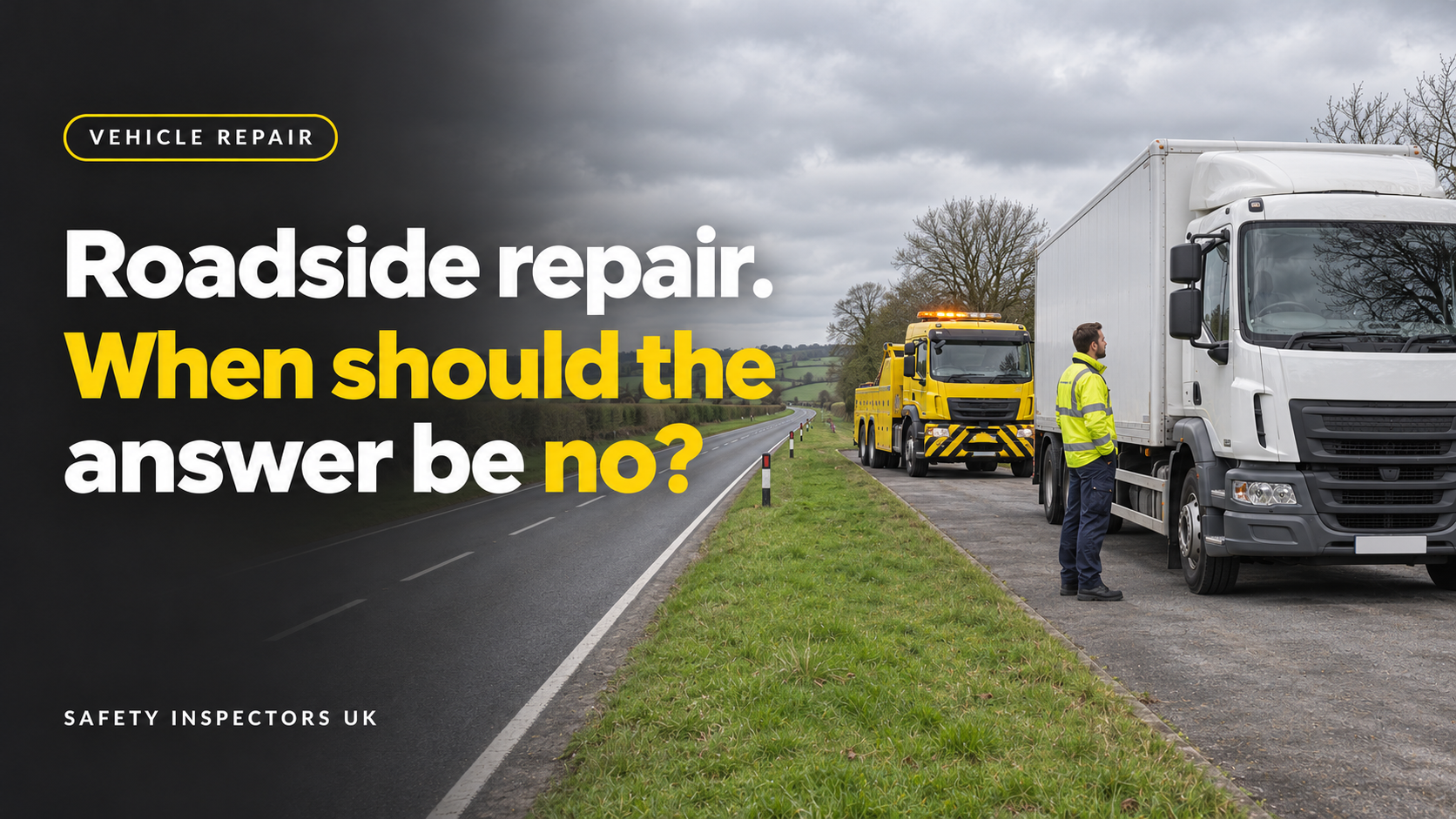
The customer wants moving.
The technician wants to help.
Does the job have a safe stopping point?
For a mobile repair business, getting a vehicle back on the road is the service. Recognising when a repair should not go ahead is part of delivering that service safely.
A recent HSE prosecution offers a serious reminder for tyre services, fleet operators and vehicle repair managers across the North East: instructions need to explain when to stop, escalate and arrange recovery, as well as how to carry out the repair.
What the recent case tells employers
In a report published on 4 November 2026, HSE described the death of 21-year-old tyre fitter Niall Fawcett during a roadside repair on 2 August 2024. He was working beneath a low-profile truck on an M56 slip road in Cheshire when it is understood to have slipped from a bottle jack.
HSE found shortcomings in the risk assessment and work instructions, including guidance on when a vehicle should be recovered instead of repaired at the roadside. It also identified a lack of monitoring and supervision for a worker who had obtained his roadside commercial tyre licence less than four months before the incident.
Halford Commercial Fleet Services Limited was fined £600,000 at Warrington Magistrates’ Court on 3 November 2026 after pleading guilty to breaching section 2(1) of the Health and Safety at Work etc. Act 1974.
The lesson for managers is to make the decision to stop a planned and supported part of the job.
Does your procedure explain when to say no?
A method statement can describe a normal job very well and still leave a technician without a clear answer when the conditions are different. Low clearance, unsuitable ground, restricted working space or missing equipment can change what is possible.
HSE’s motor vehicle repair guidance, HSG261, recognises that roadside work needs an assessment of the particular conditions and that recovery to a workshop may be safer than attempting a repair where the vehicle has stopped.
Put that decision into the procedure. Set out the circumstances that require escalation, who is available to make the next decision and what to do if they cannot be reached. Make clear that an unresolved safety concern does not become permission to continue because the customer is waiting.
Dispatch staff need the same message. A booking described as a straightforward tyre replacement should not commit the attending technician to completing it regardless of what they find.
Would your instructions help with an awkward job?
SIUK can help review risk assessments and working arrangements so that responsibilities, limits and practical controls are clear before work starts.
A jack lifts. Suitable support protects.
HSE’s guidance on working under vehicles is clear: never work beneath a vehicle supported only by a jack. Use appropriate support and follow the vehicle and equipment manufacturers’ instructions.
Suitability involves more than checking that something is available in the van. The vehicle’s lifting and support points, equipment capacity, condition and the ground all matter. If a safe method cannot be established with the available equipment, do not improvise.
Air suspension introduces additional hazards. HSE warns against going beneath an air-suspended vehicle without proper support. This article is a management review prompt, not a lifting or recovery procedure; the particular vehicle and task need competent assessment.
A certificate is the start of the conversation.
Ask how the business checks that someone can apply their training to the vehicles and conditions they will actually encounter. What work have they demonstrated? What still needs supervision? What happens when the next call falls outside their experience?
A phone number for advice is useful, but it is not the whole supervision plan. Managers should decide what observation, support and follow-up are appropriate, particularly for people new to the work or the organisation.
HSE’s roadside precautions cover assessed risks, suitable maintained equipment, training and appropriate PPE. High-visibility clothing helps visibility; it does not remove traffic exposure or make an unsuitable repair location acceptable.
Five checks before the next call-out
- Test the limits. Ask a technician to explain when they would stop and request recovery.
- Check the escalation route. Confirm who answers, who has decision-making authority and the out-of-hours arrangement.
- Match the kit to the task. Review vehicle types, approved methods and equipment availability with someone competent.
- Check practical competence. Look for evidence of appropriate supervision and observed work, rather than relying on a training date alone.
- Learn from stopped jobs. Record the reason and improve dispatch information, instructions or equipment where needed.
A useful team discussion is: “Tell me about a job we should decline or recover.” If everyone gives a different answer, that is a good place to start the review.
PRACTICAL SUPPORT FOR VEHICLE REPAIR BUSINESSES
Make stopping safely part of the service.
If you manage a North East workshop, tyre service or fleet operation, we can discuss a review of your risk assessments, safe systems of work and management arrangements.
Discuss your working arrangements ↗
For help keeping reviews, training actions and improvements on track, explore our retained health and safety support.