Managing racking damage from report to safe return · 5 minute read
A damaged upright has been reported. The next shift still has orders to pick from that bay.
That is the gap warehouse managers need to close: the time between noticing damage and making sure nobody carries on as normal. An email, photograph or maintenance ticket can record the problem without controlling access to it.
For North East distribution businesses, the practical test is whether an unfamiliar shift supervisor can identify the affected location, see its restrictions and find out who can authorise its return. The same principles apply across Great Britain; this is established guidance, not a new regional requirement.
Give every report a location and an owner
Use a consistent aisle, run and bay reference. Ask staff to report impacts and visible damage immediately, even if the rack still looks upright. A photograph can help identify the location, but workers should not approach an unstable area or climb racking to obtain one.
Name the person responsible for racking safety and a deputy for absence. Make the reporting route usable during early, late and weekend shifts. Explain that staff are expected to report concerns promptly; they are not being asked to calculate the remaining strength of a damaged component.
Record what was seen, when it was reported, the exact location and the immediate action taken. Keep the report open until someone has checked the outcome. A ticket marked “sent to supplier” should still show who is protecting the area today.
Control use while the damage is assessed
HSE’s warehousing guide HSG76 describes immediate reporting, a nominated racking-safety lead and a graded response to damage. Where damage affects safety, it calls for offloading and controls to prevent use until remedial work is completed. The response depends on competent assessment of the damage; a supervisor should not guess a colour classification from a photograph.
Keep people away from suspected unsafe racking and obtain competent advice promptly. Plan any offloading safely: sending a truck or picker straight into a potentially unstable area can create further danger. Agree the affected area and safe method with the competent person, including any neighbouring locations that need restrictions.
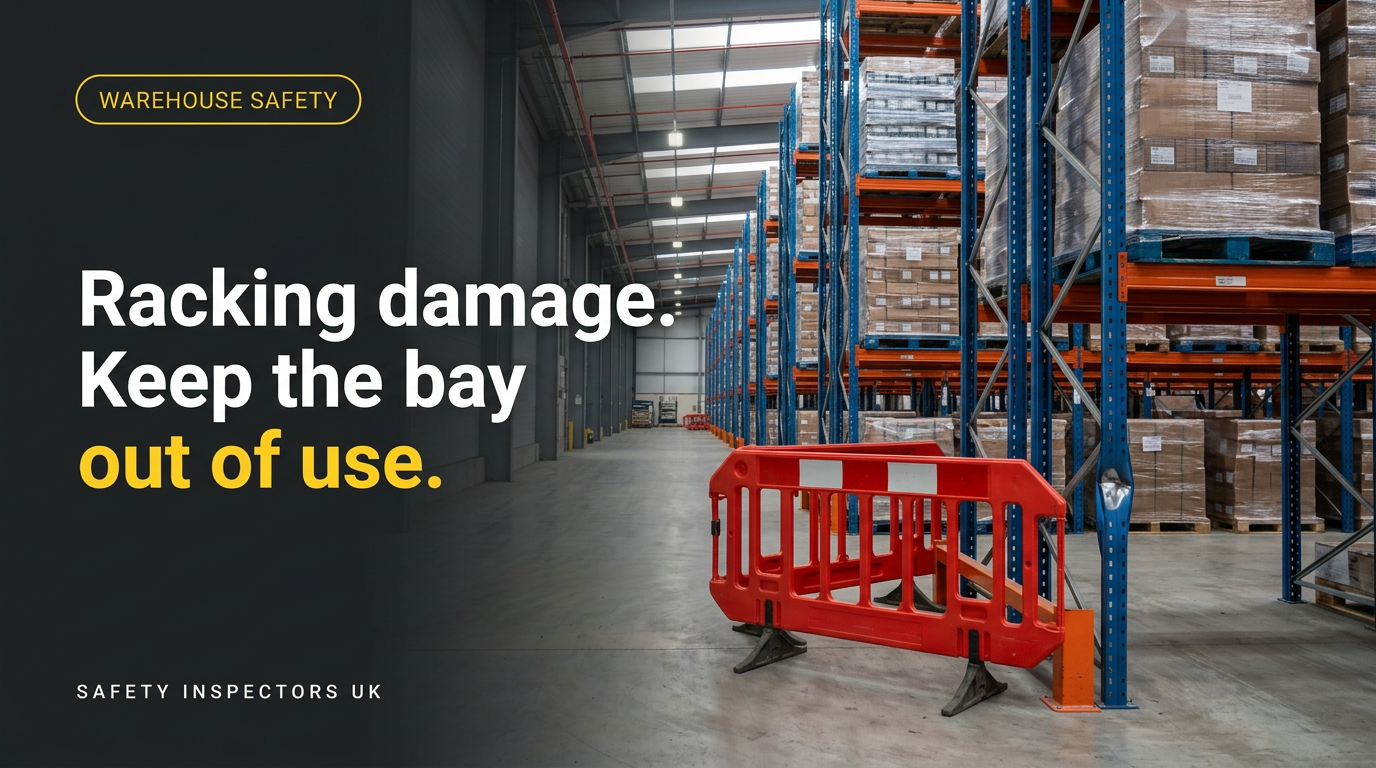
Make the restriction work physically and operationally. Suitable barriers and clear notices should match any blocked stock locations in your warehouse system. Tell the picking team where replacement stock can be obtained. A screen warning alone will not stop someone approaching the bay.
Check the management arrangements around your racking
A workplace inspection can help identify gaps in reporting, access controls and action tracking. Specialist structural assessment of racking should be undertaken by a suitably competent person.
Explore health and safety inspections →Use three levels of inspection
HSE’s short warehousing guide recommends immediate reporting of defects, regular visual checks and expert inspections. These serve different purposes. A scheduled inspection next month does not resolve damage reported today.
HSG76 recommends visual inspections weekly or at other regular intervals determined by risk assessment, with written records, and technically competent inspections at intervals no longer than 12 months. These are HSE guidance recommendations, not a claim that every warehouse has a separate statutory “annual racking certificate” requirement.
HSE’s explanation of PUWER inspection duties makes the legal distinction: inspection is required in specified circumstances, including deterioration that could create danger and exceptional events liable to jeopardise safety. Set the arrangements using risk assessment, operating conditions and manufacturer advice.
Decide who can release the bay
Before work begins, agree what evidence is needed to close the restriction: the competent assessment, the repair details and confirmation that the affected equipment is safe for its intended use. Do not treat a delivered replacement part or a contractor leaving site as the release decision.
Keep the repair record against the same bay reference. Brief the next shift, update stock-location restrictions and remove barriers only when the agreed release has been authorised. If the operating arrangement has changed, check that load information and staff instructions remain appropriate.
Then ask why the impact happened. Review the manoeuvre, available clearance, stock placement and operator observations. Repeated damage at the same position needs a prevention action as well as another repair.
Five questions for the next handover
- Can everyone identify the restricted aisle and bay?
- Are access controls and stock-system restrictions consistent?
- Who owns the assessment, repair and follow-up?
- What evidence and authorisation are needed before reuse?
- Has the cause of the damage been reviewed with the team?
Pick one open damage report and follow it through those questions. If the answers sit in different inboxes, bring them into one clear record that each shift can use.
Turn open reports into completed safety actions
Safety Inspectors UK can discuss workplace inspections and ongoing management support. Explore retained safety services, or tell us where your reporting and follow-up arrangements are getting stuck.
Request supportSources checked: 17 November 2026. Linked HSE guidance: HSG76, second edition 2007, paragraphs 641–652; INDG412; and inspection of work equipment. This article applies the guidance to management practice and does not assess any particular rack.
Cover: AI-generated warehouse illustration, not a real customer or incident.