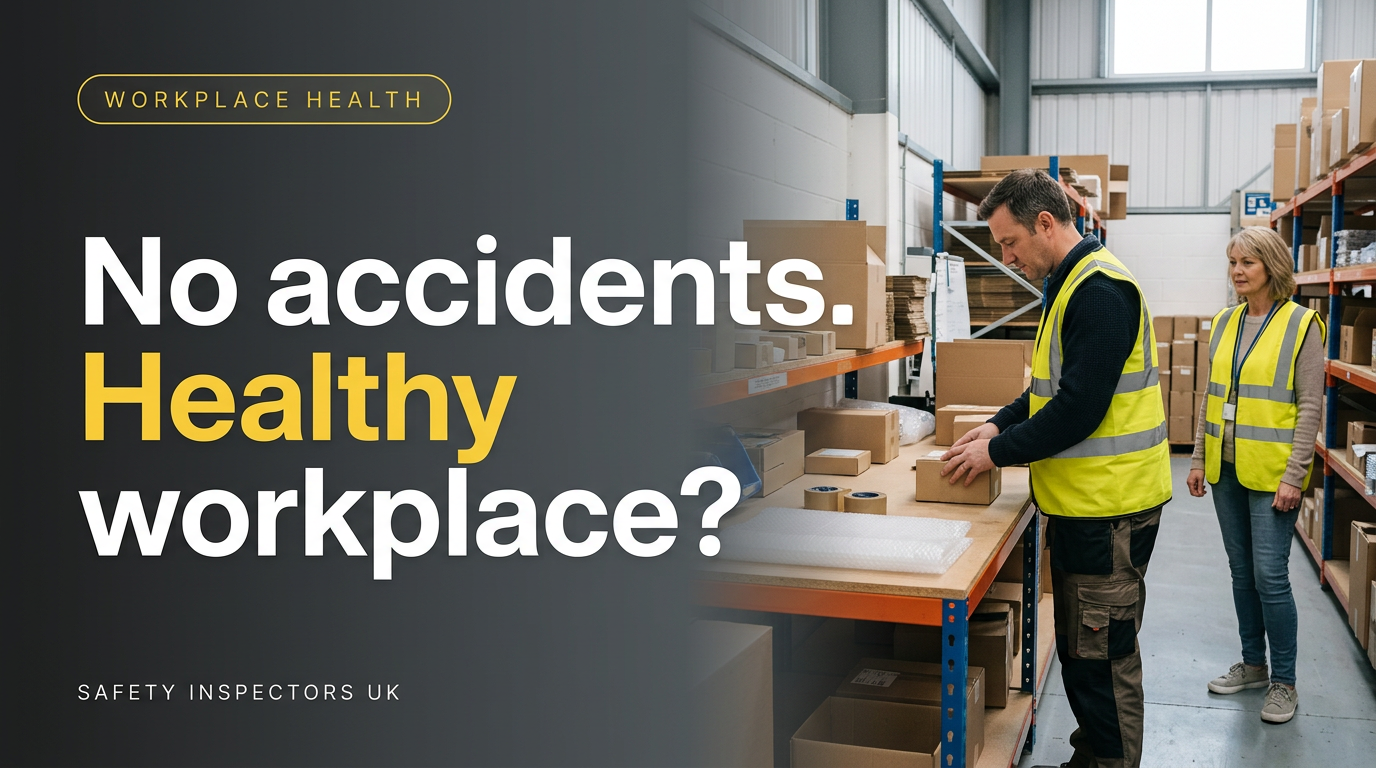
Your monthly report says there have been no accidents. Before closing the safety discussion, ask a second question: what evidence shows that the work is protecting people’s health?
An injury count cannot tell you whether repetitive work has become harder, exposure controls are effective or staff concerns are being resolved. HSE’s latest annual figures give business owners a timely reason to broaden the report they use to make decisions.
What HSE’s new figures actually cover
HSE’s 2025/26 headline figures for Great Britain estimate that 1.8 million workers suffered work-related ill health. An estimated 39.6 million working days were lost to work-related ill health and non-fatal workplace injuries. These are national figures, not estimates for the North East or your business.
The accompanying HSE release is dated 20 November 2026 and says the statistics were published on Thursday 19 November. The reporting period is April 2025 to March 2026. HSE describes the overall rates of work-related ill health and working days lost to illness as broadly flat over the past four years.
The practical message is prevention. These figures do not establish what caused an individual absence, and a change in a national total does not prove that your own controls have improved.
Add evidence about the work, not just the outcome
HSE’s management guidance explains that employers need arrangements to plan, organise, control, monitor and review protective measures. Those are legal responsibilities; the particular format of your management report is a practical choice.
For a distribution business, for example, the useful discussion might cover packing tasks, repeated handling, cleaning products and workload changes. Start with your actual risk assessments. Avoid filling a standard spreadsheet with hazards that do not exist in your operation.
Choose a few measures that help someone decide what to do. Alongside an accident total, report which important checks were due, which were completed, what failed and whether the failure has been resolved. A percentage on its own can conceal the one overdue action that matters most.
Does the report match the workplace?
Our health and safety inspections can help compare documented arrangements with work in practice and identify useful follow-up actions.
Look for problems before someone is harmed
HSE’s Managing for health and safety, HSG65, distinguishes checks made before things go wrong from learning after an incident. Both belong in a sensible management system.
Make the questions specific. Has the changed packing layout been assessed? Can staff use the handling aid where the task happens? Were defects found during control checks corrected? Does the person supervising the evening shift know the agreed arrangements? These are prompts to investigate your own workplace, not findings about any particular company.
Use staff feedback to test the paperwork. HSE’s risk-assessment guidance calls for worker involvement and review when controls may be ineffective or work changes. If the same concern returns, check whether the action changed the task or merely produced another reminder.
Use occupational health input where it is needed
Health surveillance is a programme of repeated checks for work-related ill health. It is required where the relevant legal conditions are met, including certain continuing risks from noise, vibration and hazardous substances. Obtain competent advice on what your exposures require; a general wellbeing questionnaire is not a substitute.
Where a scheme is needed, check that the right workers are included and that recommendations lead to action. Occupational health professionals should normally help establish it. Keep clinical information confidential and use the appropriate management advice to improve controls, rather than asking supervisors to diagnose symptoms.
Equally, do not wait for a health check to fix an obvious exposure-control problem. Surveillance helps identify harm and assess protection; it does not make an uncontrolled task acceptable.
Five questions for the next management meeting
- Coverage: which significant health risks are missing from our current report?
- Evidence: how do we know the controls work during normal and busy periods?
- Changes: have new products, equipment, staffing or work patterns triggered a review?
- Response: who owns unresolved concerns, and what happens while a permanent fix is arranged?
- Verification: who checks that a completed action has actually improved the work?
Record decisions in plain language. ‘Review handling’ is vague. Name the task, the person responsible, the required decision and the date for checking the result. Escalate serious gaps promptly rather than leaving them for the next routine meeting.
Start with one part of the business
Choose one team or process and review its health risks alongside the people doing the work. Compare the findings with the information management currently receives. Add the missing evidence, agree actions and revisit the result. North East employers can use the national update as a prompt without assuming local rates mirror national estimates.
For ongoing help keeping assessments, checks and actions connected, explore our retained safety services.
Make the next safety review more useful
Tell us your business type, location and the arrangements you want to examine.
Request safety supportSources and scope
Sources checked: 21 November 2026. Links above are HSE primary sources. Statistics relate to Great Britain and the stated reporting period. The management checklist is practical advice, not a new legal reporting template. HSG65 is HSE guidance, third edition 2013, currently available from HSE.