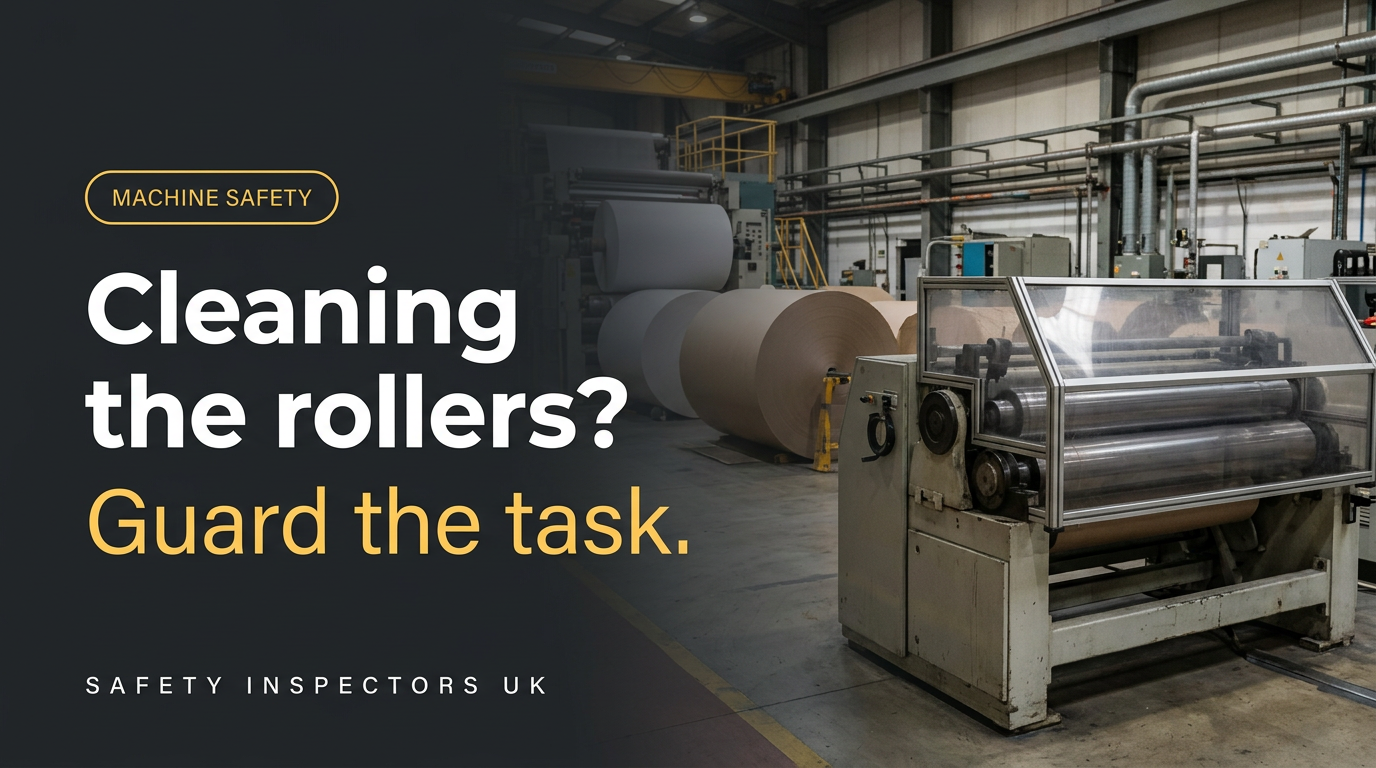
Your production checks may look reassuring. What happens when someone needs to clean the rollers?
For paper, print and packaging managers, the safety review needs to follow the whole job: running, cleaning, changing materials and dealing with faults. A routine clean can bring someone closer to dangerous parts than normal production ever does.
A recent HSE case provides a useful starting point for North East manufacturers. The prosecution concerned a business in St Helens; the management questions apply to similar work elsewhere.
What the November case tells managers
In its release published on 5 November 2026, HSE reported that an experienced operator suffered serious hand injuries while cleaning the print rollers of a napkin-making machine. The investigation found that an interlocked guard was absent, allowing access to moving rollers.
Duni Poppies Limited pleaded guilty to breaching regulation 11(1) of the Provision and Use of Work Equipment Regulations 1998 (PUWER). It was fined £80,000 at Warrington Magistrates’ Court on 3 November 2026. The release does not give the incident date: the court date should not be presented as the date of the injury.
The lesson is about the protection provided by the machine and the working method. Long experience does not make accessible dangerous parts safe. This is an enforcement example under existing law, not a new November requirement.
List the jobs that take people near the rollers
Start with one machine and speak to operators, cleaners, setters and maintenance staff. Ask what they do when paper wraps around a roller, a product marks, or a cleaning tool cannot reach the intended surface. Discuss the work without asking anyone to demonstrate an unsafe action.
Write down the distinct tasks and who is authorised to carry them out. “Operate the machine” is too broad to explain cleaning, adjustment and fault recovery. Compare the actual arrangements with the manufacturer’s instructions and the task assessment.
HSE’s PUWER overview includes cleaning within the use of work equipment. It explains the need to prevent access to dangerous parts, normally through fixed guarding or, where routine access is needed, suitable interlocked guarding. Instructions and training support those safeguards.
Ask a competent machinery specialist to assess unclear or inadequate protection. Do not approve an improvised guard, bypass an interlock or assume a warning label resolves a reachable hazard. Keep affected work stopped until suitable controls are established.
Look at the task as well as the machine.
A workplace inspection can help identify gaps between written arrangements and the way work is organised, with clear priorities for further specialist assessment where needed.
Explore workplace inspections ↗Make the cleaning method specific to the equipment
HSE’s maintenance guidance calls for moving plant to stop, power supplies to be isolated and machines to be locked off where accidental reconnection is possible. Stored energy and parts that could fall also need attention. Most maintenance should take place with power off.
Have a competent person establish the machine-specific method, including how a safe state is verified. A stop button or an open guard should not simply be assumed to provide the required isolation. This article is a management checklist, not an isolation instruction for a particular machine.
Make the practical arrangements available where the job happens: the correct instructions, authorised people, suitable equipment and a way to request help. If the method cannot be followed, staff need a clear instruction to stop and escalate rather than invent a shortcut.
Where a task genuinely requires powered movement, it needs specialist assessment and suitable protective measures. A production deadline is not a reason to allow someone to reach into an exposed danger zone.
Check the handover back to production
Agree who confirms the work is complete and authorises return to use. The handover should address people and tools being clear, safeguards being restored and checked, and outstanding defects being understood. Follow the equipment-specific procedure for removing isolation and restarting.
Include this arrangement in shift changes. A verbal message that a machine is “nearly ready” leaves too much room for assumptions. Use a clear status that the incoming supervisor can check.
Also ask why the intervention is needed so often. Repeated wrapping, marking or jams deserve investigation. Record the recurring problem, allocate an owner and review whether the corrective action reduces the need for intervention.
Five questions for your next production meeting
- Have we assessed cleaning, setting and fault recovery separately from normal running?
- Do the safeguards prevent access to dangerous parts during those tasks?
- Can authorised staff follow the equipment-specific safe method with the resources provided?
- Is responsibility for isolation, handover and return to use clear?
- Are recurring faults and reported guarding concerns tracked through to a verified fix?
Choose one action that needs attention now. Give it an owner and a realistic completion date, then check the result with the people doing the work. Where danger is immediate, stop the affected activity rather than leaving it on a future action list.
Turn the review into completed actions.
Tell us where cleaning, changeovers or recurring faults are creating uncertainty. We can discuss practical assessment support and help your team prioritise improvements.
Discuss your workplace safety ↗For ongoing action tracking, see our retained health and safety support.
Sources checked: 23 November 2026. Primary HSE sources are linked above. PUWER and the HSE guidance discussed here concern Great Britain. The practical questions support, rather than replace, a competent assessment of your machinery and tasks. Cover image: AI-generated illustration, not the machine or workplace involved in the case.