

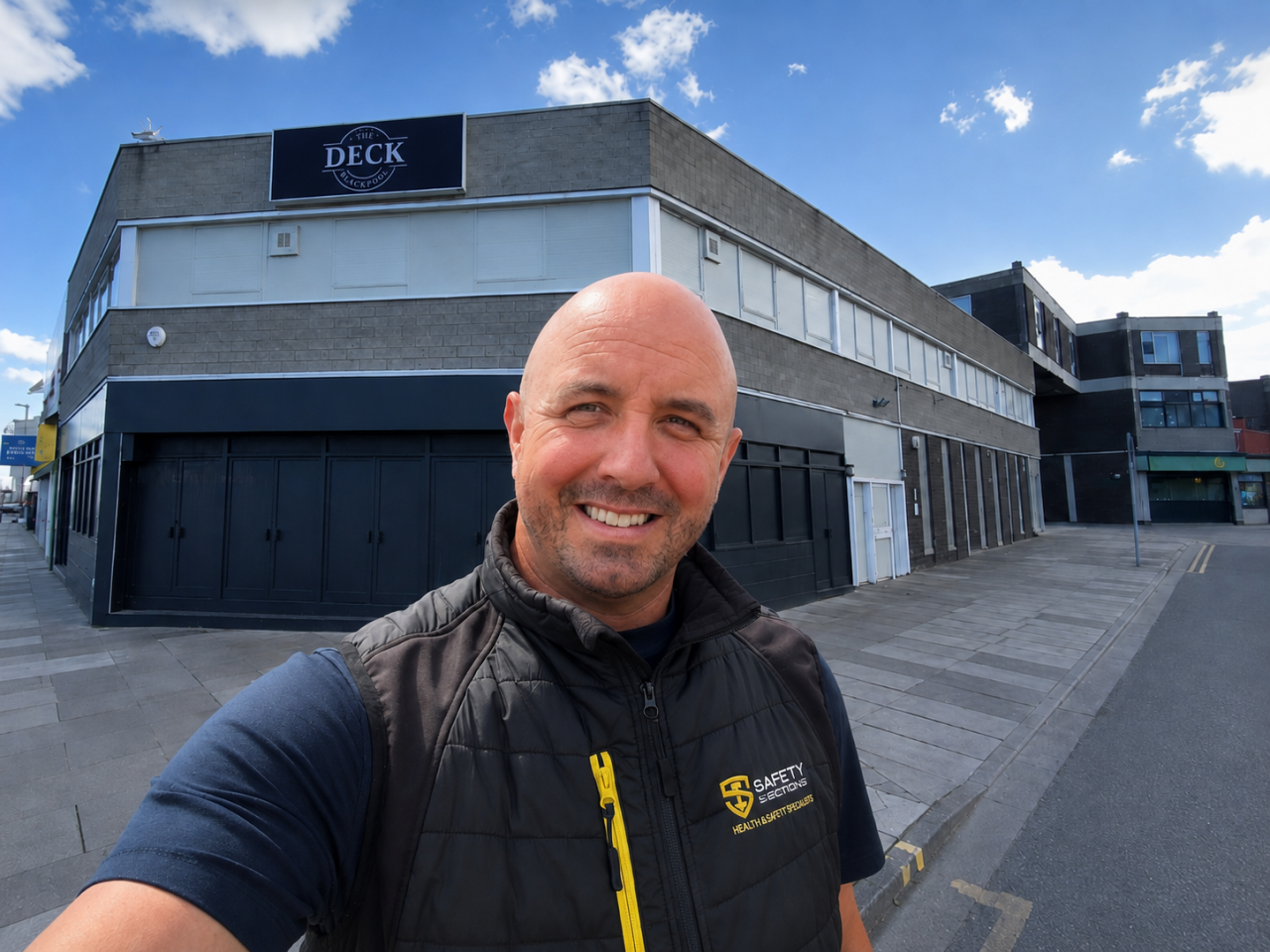
Safety Inspectors UK case study
The Deck
Nightclub fire safety training in Redcar
Around six decades of nightclub experience. Twelve members of staff. One venue-specific session designed to make sure the team knows what to do when the music stops and every second matters.
The case study at a glance
Venue: The Deck Nightclub, formerly the Top Deck
Location: Redcar, Teesside
Team attending: 12 members of staff
Senior leadership: Venue director Tony Zivanaris attended the full session
Training delivered: Fire awareness, fire warden instruction and controlled practical fire extinguisher training
The Deck is not a newly opened venue trying to find its feet. It is part of Redcar’s nightlife history—and that is exactly what made this fire-safety training case study so interesting.
Formerly known as the Top Deck, the nightclub opened in Redcar in 1967 and has welcomed generations of customers through its doors.
The session was attended by 12 members of staff, including director Tony Zivanaris, who is closely associated with The Deck and the wider North East nightclub industry.
Tony’s wider career included the TAZ Leisure group and nightclub venues such as the Madison in Middlesbrough and Newcastle upon Tyne, alongside the Top Deck and other hospitality businesses across the region.
His decision to attend alongside the team demonstrated something important: even after decades in the nightclub industry, effective fire safety still depends on current training, clear procedures and staff who understand the venue in which they work.
The biggest risk is not always the fire.
It is the music that keeps playing. The crowd heading for one entrance. The customer going back for a coat. The damaged vape hidden in a cloakroom. The few seconds lost while somebody decides whether the alarm is real.
The challenge at The Deck
Nightclub fire safety is different from fire safety in a quiet office, shop or warehouse. At The Deck, the training had to reflect the conditions staff could face during a live event.
A real nightclub evacuation may involve:
- Loud music preventing customers from hearing or recognising the fire alarm.
- Reduced lighting making exits, stairs and changes in floor level harder to identify.
- Crowding around dancefloors, bars, cloakrooms, toilets, stairs and entrances.
- Alcohol affecting judgement, reaction time, behaviour or mobility.
- Customers who are unfamiliar with the premises and its alternative exits.
- Visiting DJs, performers, promoters and contractors using temporary equipment.
- Extensive lighting, sound and electrical equipment operating for long periods.
- Phones, vapes and power banks containing lithium-ion batteries.
- People attempting to retrieve coats, drinks, phones or friends before leaving.
Customers may follow familiarity instead of safety.
People often try to leave through the same entrance they used on arrival, even where another exit is closer and safer. Staff must know every available escape route and be ready to direct people away from congestion.
What Safety Inspectors UK delivered at The Deck
This was not a generic presentation dropped into a nightclub. The session was developed around nightclub hazards, crowd behaviour, the role of venue staff and the practical decisions employees may have to make during an emergency.
The Deck training element 01
Fire awareness training
The team examined how fires start and spread, including the three elements of the fire triangle: heat or ignition, fuel and oxygen.
Possible nightclub ignition sources include amplifiers, lighting, damaged electrical equipment, overloaded sockets, chargers, cooking equipment, smoking materials and unauthorised flame effects. Fuel can include furniture, upholstery, coats, waste, decorations, drapes, acoustic materials and plastics.
The Deck training element 02
Fire warden training
Nominated wardens and managers considered pre-opening checks, allocated zones, safe sweep procedures, normal and alternative exits, customer direction, assembly-point control and accurate reporting.
The role was kept clear: a warden sweeps while moving towards safety. A warden does not enter smoke, pass a fire, conduct an unplanned rescue or remain inside simply to be the last person out.
The Deck training element 03
Practical fire extinguisher training
The team took part in a controlled practical exercise covering extinguisher identification, safe positioning, maintaining an escape route, aiming correctly, controlling the discharge and withdrawing safely.
The aim was not to turn employees into firefighters. It was to help staff understand what an extinguisher can do, what it cannot do and when leaving immediately is the safest decision.
Real scenarios the team worked through
The most valuable training places people in situations they could realistically face. The Deck team considered how nightclub staff should respond to incidents such as these.
Scenario one
A vape starts hissing inside a cloakroom
The device must not be picked up, placed in a pocket or carried through the crowd. Staff should raise the alarm, move people away, begin the evacuation, call 999 and report that a lithium-ion battery is involved.
Scenario two
Smoke appears from the DJ booth
Staff should raise the alarm immediately rather than waiting for automatic detection, stop the music under the venue procedure, call 999 and direct customers towards all available safe exits.
Scenario three
A customer tries to return for a coat and phone
Staff should give a clear instruction, prevent re-entry and seek support from security or management where required. Property can only be recovered after the premises have been declared safe.
Do not pick it up. Do not carry it through the crowd.
A phone, vape or power bank that is smoking, hissing, rapidly swelling or burning can change condition quickly.
Raise the alarm → Move people away → Evacuate → Call 999 → Report the battery hazard
The best emergency is the one prevented before opening
The Deck team also considered the everyday checks that reduce the likelihood of an emergency developing during a busy night.
A meaningful pre-opening check should identify:
- Escape routes obstructed by furniture, barriers, stock, queues or waste.
- Final exits that are locked, difficult to open or blocked outside.
- Fire doors that are wedged open, damaged or unable to close fully.
- Exit signs, alarm call points or emergency lights hidden by decorations.
- Extinguishers that have been moved, concealed or damaged.
- Damaged leads, discoloured plugs or overloaded electrical adaptors.
- Drinks or liquids positioned close to electrical equipment.
- Unauthorised candles, sparklers, pyrotechnics or flame effects.
- Unsafe charging of phones, vapes, radios or power banks.
- Crowding that creates unsafe pinch points around exits, bars or stairs.
See it. Report it. Correct it. Do not walk past it.
When the alarm sounds, clarity wins
Vague instructions create vague results. Staff practised using short, direct language that tells customers what to do and where to go.
The smartest extinguisher decision may be not to use one
Portable fire extinguishers are intended for very small fires in their earliest stage. They are not provided so that staff can remain in a burning building.
Before an extinguisher is even considered:
- The alarm must already have been raised.
- The evacuation must be underway.
- 999 must have been called or the call must be in progress.
- The person must have received suitable training.
- The fire must be very small, contained and in its earliest stage.
- The correct extinguisher must be available.
- Smoke and heat must not prevent a safe approach.
- A clear escape route must remain behind the person.
Staff were taught to stop and withdraw if the fire did not reduce immediately, smoke or heat increased, the fire spread, the equipment failed or their escape route became threatened.
What this case study shows
The Deck is an established nightclub run by people with decades of operational experience. Yet the session still identified why structured, current and venue-specific fire safety training matters.
The lessons extend beyond one nightclub:
- Experience does not replace a clear emergency plan.
- A fire alarm is only effective when staff know how to respond.
- Wardens need defined zones, exits and reporting routes.
- Customer behaviour must be considered—not assumed.
- Modern battery risks must form part of nightclub training.
- Practical extinguisher experience must be paired with clear limits.
Fire safety responsibilities for Redcar venues
The Deck is within the area served by Cleveland Fire Brigade, which provides local business fire-safety guidance.
Businesses should have a suitable and recorded fire risk assessment, appropriate fire precautions, emergency arrangements and suitable employee training.
The Home Office publishes specific guidance for small and medium places of assembly and large places of assembly, including large nightclubs.
Further information about the legal duties of the Responsible Person is available through GOV.UK workplace fire safety responsibilities.
Case study conclusion
A strong commitment from The Deck team
The attendance and participation of 12 staff members, including Tony Zivanaris, demonstrated a positive commitment to protecting employees, performers, contractors and customers.
Safety Inspectors UK would like to thank Tony and the entire team at The Deck for their contribution, questions and engagement throughout the session.
Nightclub fire safety training: common questions
Do nightclub staff need fire safety training?
Employees must receive suitable fire-safety information, instruction and training. In a nightclub, the training should reflect the actual alarm, exits, customer behaviour, staff roles and hazards within the venue.
What does nightclub fire warden training cover?
Training should cover pre-opening checks, allocated zones, safe sweeps, normal and alternative exits, customer direction, reporting procedures, assembly-point control and the limitations of the warden role.
Should nightclub staff use fire extinguishers?
Only trained staff should consider using a suitable extinguisher on a very small, early-stage fire when evacuation is underway and a clear escape route remains available. Nobody should put themselves at risk to protect property.
Where is nightclub fire safety training available?
Safety Inspectors UK provides fire awareness training, fire warden training, practical extinguisher sessions and fire risk assessments in Redcar, Middlesbrough, Stockton-on-Tees, Hartlepool, Darlington, Durham, Newcastle, throughout the North East and across the UK.
Fire safety support for nightclubs and licensed premises
Safety Inspectors UK provides venue-specific fire safety support for nightclubs, pubs, bars, restaurants, live-music venues, hotels, event spaces and other licensed premises.
- On-site fire awareness and safety training.
- Fire warden and fire marshal training.
- Fire extinguisher services and practical instruction.
- Commercial fire risk assessments.
- Fire safety management support.
- Emergency evacuation planning and fire drills.
- Fire safety inspections and compliance support.
Fire safety training across Redcar, Teesside and the North East
Do not wait for an alarm to expose the gaps.
Get nightclub fire safety training built around your venue, your staff, your exits and your actual risks—not a generic course designed for somebody else’s workplace.
Discuss your venue’s fire safety training
Call 0330 1226 337 or email help@safetyinspectors.co.uk.