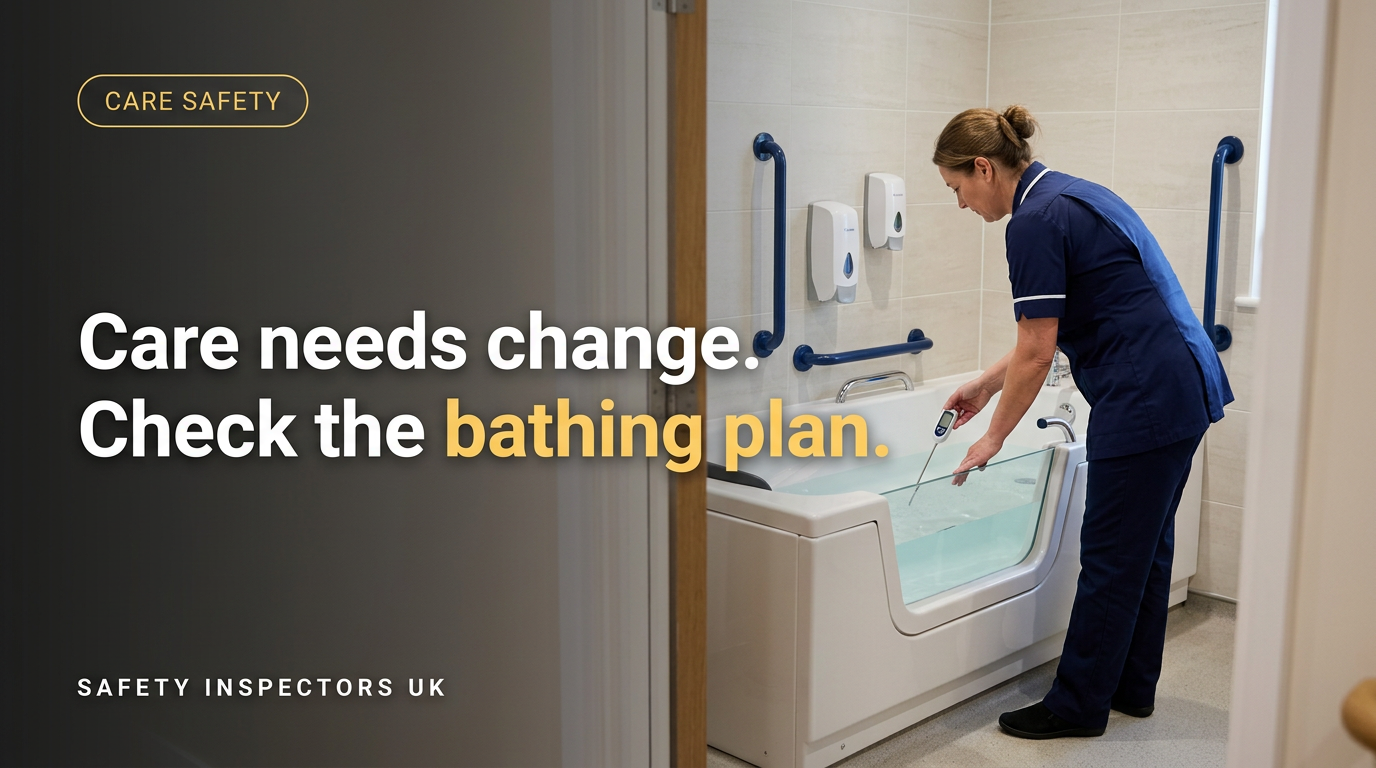
Reviewing bathing arrangements when needs change · 5 minute read
A resident needs more help getting out of the bath. Has the bathing plan changed with them?
A bathroom can have the same fittings, the same maintenance record and the same written procedure while the person using it faces a different risk. Reduced mobility, altered temperature sensitivity or difficulty asking for help can make yesterday’s arrangements unsuitable today.
For care-home managers in the North East, the practical job is to connect the individual care assessment with the building’s scalding controls. Neither record should sit in isolation. This guide uses national HSE advice; it does not announce a new rule or describe a customer incident.
Notice when the person’s needs have changed
HSE’s guidance on hot water and surfaces says assessments should consider vulnerability alongside the premises. Relevant questions include whether a person can recognise excessive heat, move away, summon assistance or run additional hot water when unattended. Mobility aids and bathroom fittings can also affect their ability to respond.
Make those questions part of a review when care needs change, rather than waiting for the next routine paperwork date. A return from hospital, a new difficulty transferring or a concern raised by the resident should prompt staff to check whether the existing plan still works.
Record the practical result: which bathing facilities are suitable, what assistance is needed and what staff should do if the usual arrangement is unavailable. “Assist as required” gives the next member of staff too little information to work with.
Check the temperature controls at the point of use
HSE’s scalding guidance states that where vulnerable people are at risk during whole-body immersion, water temperatures must not exceed 44°C. That is not a universal target temperature for every bath. Follow the individual assessment, applicable sector guidance and your safe bathing procedure, which may require lower temperatures.
Baths and showers need suitable controls where high temperatures could reach vulnerable users. Thermostatic mixing valves blend hot and cold water near the outlet, but their presence alone does not prove they are working. HSE calls for outlet temperatures and valves to be monitored and maintained.
Identify each relevant outlet in the maintenance record. Staff should know how to carry out the checks required by the bathing procedure, what the acceptable limits are and who to contact about an unexpected reading. Do not rely on a hand test as the sole temperature check. Use suitable equipment and a defined method.
Do the care and maintenance records join up?
A workplace inspection can help review responsibilities, records and follow-up arrangements. Specialist water-system work and individual care decisions need appropriately competent people.
Explore health and safety inspections →Make an abnormal reading lead to a clear action
Agree a response before someone finds an outlet outside the safe range. Stop using the affected facility for the planned bathing activity, protect against accidental reuse and arrange competent investigation. Provide an assessed alternative that preserves privacy and meets the person’s care needs.
Give the fault a named owner and a location reference. Record what was found, the immediate restriction, who was informed and what is required before the facility returns to use. A maintenance visit booked for tomorrow is not evidence that it is safe today.
Do not casually reduce the building’s stored hot-water temperature to solve an outlet problem. HSE’s hot and cold water guidance explains the need to manage scalding alongside legionella control. Have competent people coordinate changes so that reducing one risk does not increase another.
Keep independence and dignity in the decision
HSE’s sensible risk-assessment guidance for care settings supports proportionate decisions that balance safety with the individual’s needs and freedoms. Involve the person and, where appropriate, their carers or family. Avoid assuming that everyone needs the same restriction because one resident is particularly vulnerable.
Explain the agreed approach to the staff who will provide care, including temporary staff. Check that they can find the current plan and know when to stop and seek help. Respectful support depends on clear instructions, suitable facilities and enough time to follow the plan.
Five checks for the manager
- Individual: does the assessment reflect current mobility, awareness and ability to call for help?
- Facility: is the selected bath or shower suitable, with effective temperature controls?
- Procedure: do staff know the required checks, assistance and safe limits?
- Fault response: can the outlet be kept out of use and an assessed alternative arranged?
- Follow-up: is there recorded evidence before normal use resumes?
Choose one bathing plan and trace it through the outlet records, staff instructions and fault-reporting process. Close any gaps with a named action and review date.
Build a clearer system for safety follow-up
Safety Inspectors UK can discuss inspections and ongoing management support. Explore retained safety services or tell us which responsibilities and actions need attention.
Request supportSources checked: 18 November 2026. Linked HSE guidance includes HSIS6 (published 2012), scalding and burning, hot and cold water systems, and sensible care risk assessment. These explain established duties and good practice. For CQC-registered providers with premises in England, CQC is the relevant regulator for patient safety matters.
Cover: AI-generated illustrative care bathroom; not a real resident, customer or incident.