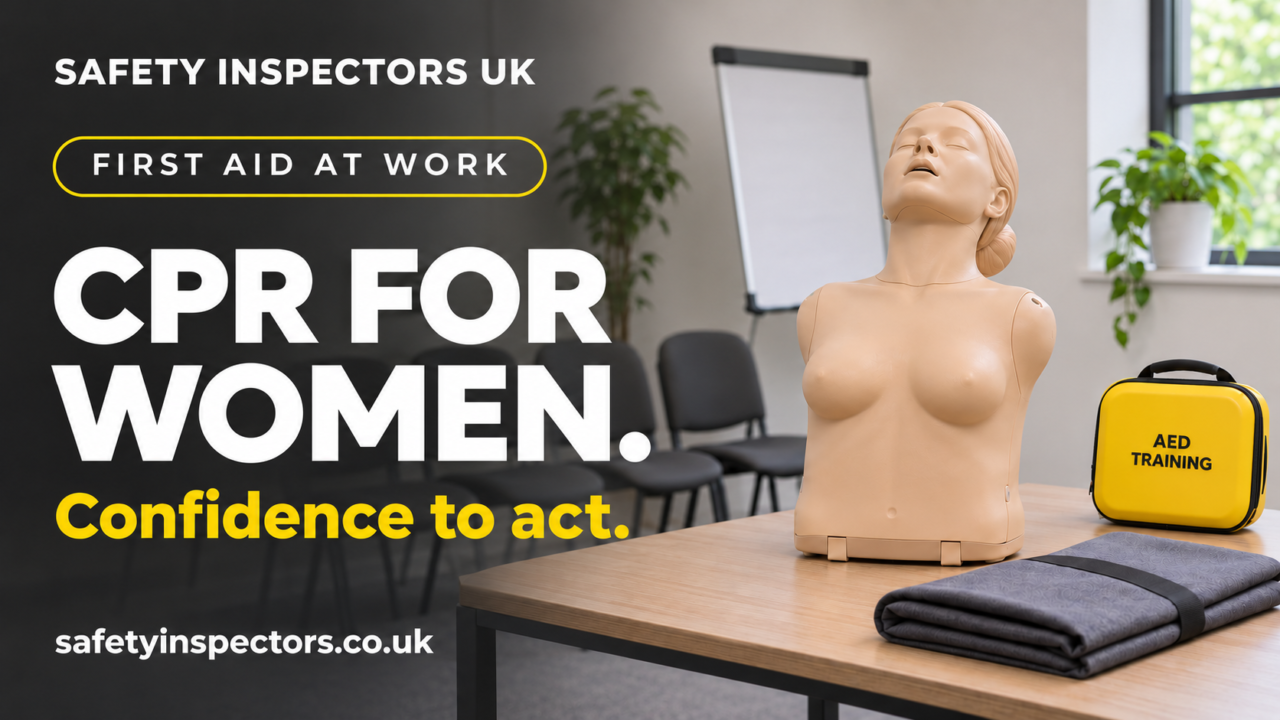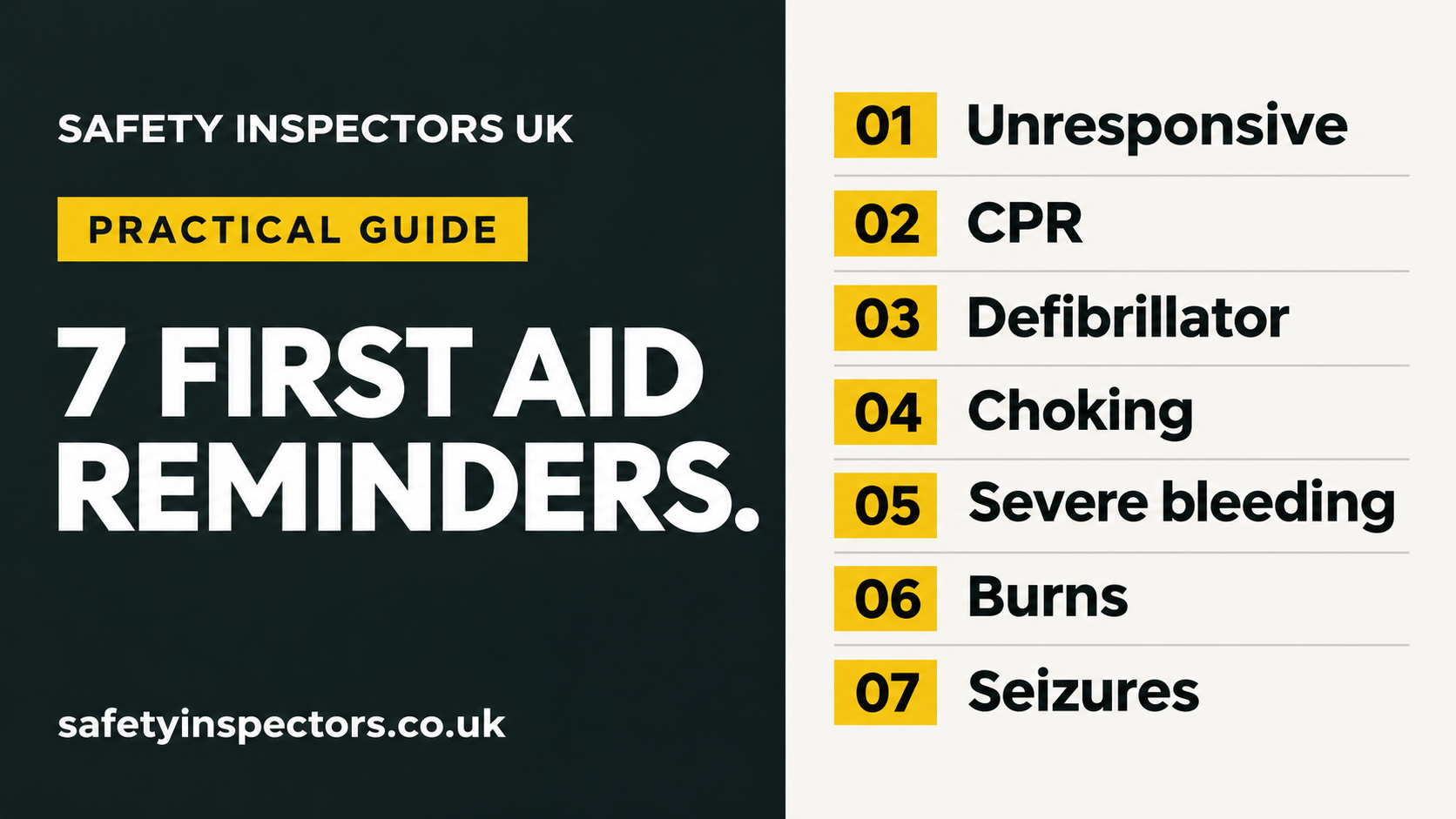
FIRST AID AT WORK · PRACTICAL REFRESHER
When did your team last practise first aid?
A course gives you a starting point. Regular practice helps you stay ready to use it. These seven reminders cover key actions for adult emergencies at work.
Before you help: check it is safe to approach. Shout for help. In a life-threatening emergency, call 999 and follow the call handler’s instructions.
This guide supports practical training. It is not a complete first aid course or a guide for babies and children. The numbers below identify topics, not a sequence to follow for every casualty.
Unresponsive? Call 999.
Call 999 straight away. Put your phone on speaker and assess breathing while the call connects.
If they are breathing normally, place them on their side in the recovery position and keep checking their breathing. If you suspect a traumatic injury, avoid rolling them routinely; follow the call handler’s instructions about protecting their airway.
Gasping is not normal breathing. If breathing is absent or abnormal, start CPR.
Not breathing normally? Start CPR.
Push in the centre of the chest, 100–120 times a minute, to a depth of 5–6 cm.
For an unresponsive adult with absent or abnormal breathing, place the heel of one hand in the centre of the chest, with the other on top. Keep your arms straight and let the chest rise fully between compressions.
If trained and able, give 30 compressions followed by 2 rescue breaths. Otherwise, keep giving chest compressions. Follow the call handler.
Continue until help takes over, the person shows clear signs of life and normal breathing, or you cannot physically continue.
Defibrillator? Switch it on.
Attach the pads to the bare chest as shown. Follow the spoken instructions.
Ask someone to fetch an automated external defibrillator (AED) while CPR continues. Anyone can use one; you do not need a certificate.
Make sure nobody touches the person while the AED analyses their heart rhythm or delivers a shock. Restart CPR promptly when instructed. The AED decides whether a shock is needed.
Choking? Cough, then act.
If they can cough effectively, encourage coughing. Stay with them.
If coughing is ineffective, give up to 5 back blows. If these do not clear the blockage, give up to 5 abdominal thrusts. Stop as soon as the blockage clears.
If still choking, call 999 and alternate back blows and abdominal thrusts. If they become unresponsive, start CPR. Do not blindly put your fingers in their mouth.
Abdominal thrusts are not suitable during pregnancy or when you cannot encircle the abdomen; use chest thrusts instead. Seek medical assessment after abdominal or chest thrusts.
Severe bleeding? Apply pressure.
Apply firm, direct pressure and get someone to call 999.
Use a sterile dressing or clean, non-fluffy cloth. Wear first aid gloves if available. If an object is embedded in the wound, leave it in place and press on either side, not on the object.
Keep pressure on the wound. If bleeding is not controlled, tell the call handler immediately and follow their instructions. Specialist dressings and tourniquets may be needed for life-threatening bleeding; use these within your training or as directed by emergency services.
Keep the person warm and monitor their responsiveness and breathing.
Burn or scald? Cool for 20 minutes.
Use cool running water for a full 20 minutes. Start as soon as possible.
Remove nearby jewellery and clothing, but leave anything stuck to the skin. Do not apply ice, creams, oils or butter.
After cooling, lay cling film loosely over the burn; do not wrap it around a limb or put it over the face. Keep the rest of the person warm.
Very large or deep burns, burns to the face or genitals, and electrical or chemical burns need emergency assessment. Call 999 where an ambulance is needed. Chemical burns need specific decontamination advice: follow emergency-service instructions. Contact NHS 111 if unsure about a less serious burn.
Seizure? Protect them. Time it.
Clear nearby hazards, cushion their head and note when it starts.
Do not restrain them or put anything in their mouth. Move them only if there is immediate danger. Stay with them and speak calmly as they recover.
When the shaking stops, check breathing. If breathing normally, use the recovery position where appropriate. If unresponsive and not breathing normally, call 999 and start CPR.
Call 999 for a first seizure, one lasting longer than usual or more than 5 minutes when the usual duration is unknown, repeated seizures without recovery, failure to regain consciousness, serious injury or breathing difficulty.
Someone with known seizures may have an individual care plan. Follow it if you know what to do and have the necessary training. Do not assume every seizure has the same cause.
Five checks for your next team briefing
- People: who provides first aid cover today, including breaks and absences?
- Equipment: where are the first aid kit and nearest AED, and can people access them?
- Access: who calls 999 and meets the ambulance? Is the site address easy to find?
- Practice: when did first aiders last rehearse a realistic scenario?
- Follow-up: are refresher training and requalification dates planned?
HSE strongly recommends annual refresher training for workplace first aiders. This recommendation is separate from certificate renewal. A short team briefing does not replace practical refresher training.
Keep your team ready.
Safety Inspectors UK provides workplace first aid training. Tell us about your team, your premises and the work you do, and we can discuss suitable training.
Explore first aid training ↗Related: First-aider off? Check your cover arrangements.