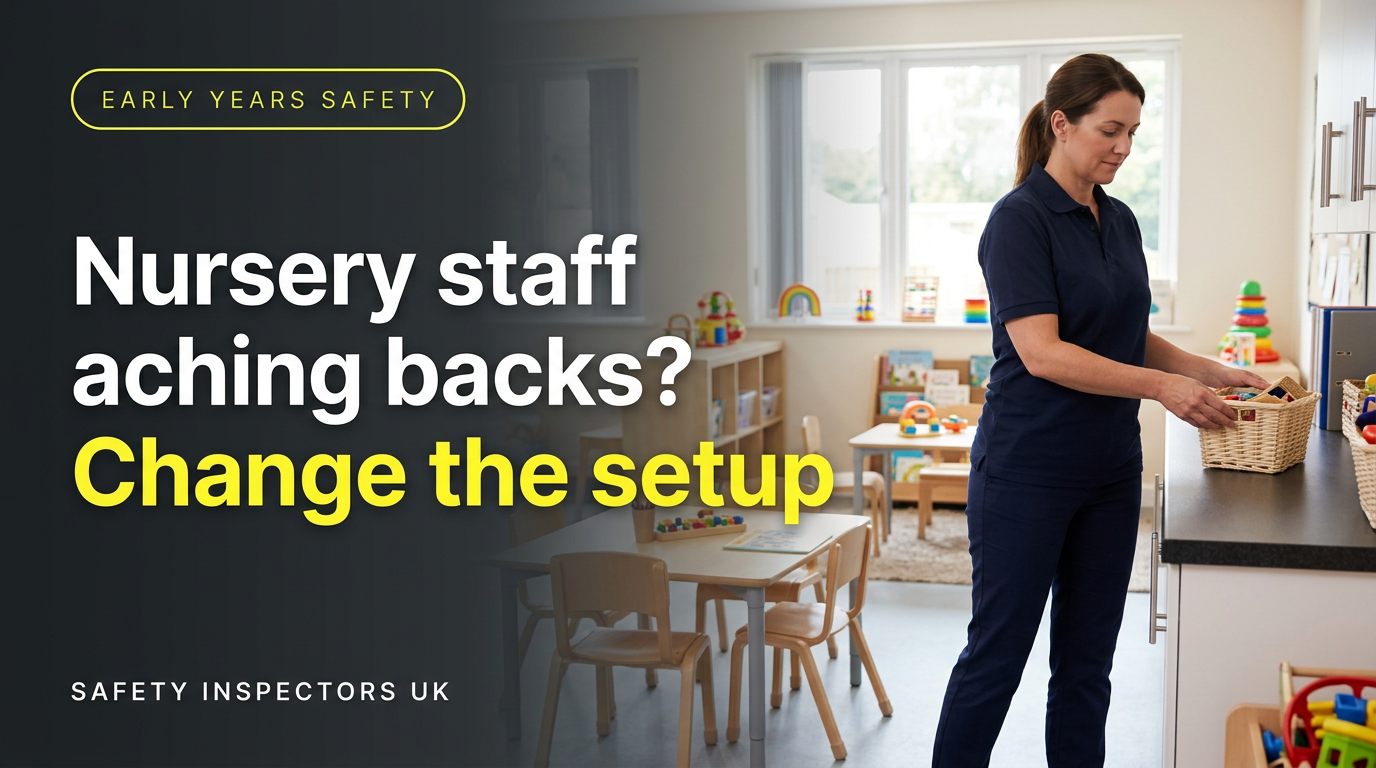
A nursery room can work beautifully for children while making every shift awkward for the adults caring for them.
Repeatedly lifting children, carrying play equipment and reaching across low furniture deserve a proper look. If staff report aching backs or describe one routine as exhausting, use that information to review how the work is organised. A reminder to ‘lift properly’ leaves the same difficult task waiting tomorrow.
For nursery owners and managers across the North East, the starting point is an ordinary working day: arrivals, changing, meals, rest time and clearing away. This guide applies national HSE principles to that setting; it does not describe a new local rule.
What the duty actually requires
HSE explains that manual handling includes supporting or moving a person as well as an object. In Great Britain, employers must avoid hazardous manual handling so far as reasonably practicable, assess what cannot be avoided and reduce the remaining risk as low as reasonably practicable. These are duties; the room-review suggestions below are practical ways to apply them.
There is no single legal weight limit that makes a lift safe. A child’s weight alone cannot tell you whether a task is acceptable: movement, reach, frequency, available space and the individual worker all matter. Do not turn a generic lifting chart into a nursery-wide permission to lift.
Watch a complete routine, not one demonstration
Ask practitioners to show where they bend, reach, carry or struggle to get close. Observe normal work without asking anyone to repeat an unsafe movement. Include setting out beds or mats, moving toy boxes and putting deliveries away, alongside caring for children.
Write down the task and the difficulty precisely. ‘Changing area: supplies behind the practitioner, causing repeated turning’ gives you something to fix. ‘Staff need more manual handling awareness’ may miss the cause. Ask whether busy periods, staff cover or a change of room make the task harder.
HSE’s assessment guidance calls for consideration of the task, load, working environment and individual capability. Talk privately about difficulties or adjustments; do not assume that experience, fitness or willingness means someone can safely manage the work.
Need a fresh look at the working environment?
A health and safety inspection can help identify practical improvements to access, storage and everyday working arrangements.
Make the next shift less physically demanding
Start with tasks you can remove or simplify. Could equipment stay where it is used, rather than being carried between rooms? Could a heavy toy collection be stored in several smaller containers? Keep frequently used supplies within comfortable reach, while preserving secure storage and children’s safety.
Review changing and care equipment for the actual users and tasks. Consider suitable working heights, room to stand close and access to supplies without repeated reaching. Follow the equipment instructions. Any proposed access steps, adjustable equipment or new layout need their own assessment for falls, trapping, stability and supervision before use.
For floor-level activities, look at suitable adult seating and opportunities to vary posture. Avoid creating a routine in which one person spends prolonged periods folded over child-sized furniture. Moving a cupboard or changing the sequence of clearing away may be more useful than issuing another poster.
Handling a child is not the same as carrying a box. Consider the child’s needs and likely movements, and agree appropriate support and help for the particular task. Where care needs make handling complex, obtain competent advice and a suitable individual plan. Never reduce supervision or rush care to make a handling target easier to meet.
Train people for the arrangement you actually use
HSE says training alone will not ensure safe manual handling. First make the operation as safe as reasonably practicable, then give practical instruction that fits the nursery’s equipment and routines. Include new starters and staff covering another room.
Make asking for help straightforward. Staff should know whom to contact when a task feels unsafe, equipment is unsuitable or a child’s needs change. Encourage early reporting of discomfort so the task can be reviewed, rather than treating pain as part of the job.
A manager’s checklist for this week
- Observe one busy care routine and one clearing-away routine.
- Ask staff which lifts, reaches or working positions they find most difficult.
- Identify handling that can be removed, shortened or made easier.
- Check storage, equipment access and working height without compromising child safety.
- Record agreed changes, an owner and a completion date.
- Brief everyone affected and check the revised routine in use.
- Set a review date and revisit sooner if discomfort or difficulties continue.
Choose one improvement you can make promptly and one that needs planning or equipment. Review whether they reduced the difficulty, including during busy periods. Keep staff involved: a change that looks tidy on a floor plan may still be awkward in practice.
Turn staff concerns into a practical action plan
For ongoing help with assessments and follow-up, explore retained safety support. Tell us about your nursery, the tasks causing concern and the changes already tried.
Request help with your workplace